Silicon Craft Technology Public Company LimitedSET: SICT🇹🇭 TH

CG Policy · 2025

Corporate Governance Policy

Introduction

Silicon Craft Technology Public Company Limited (the “Company”) is committed to conducting its business in accordance with the principles of good corporate governance and ethical business practices on a continuous basis. The Company believes that conducting business with strong governance, transparency, and accountability, while creating positive value for society, caring for the environment, and responsibly managing relationships with all stakeholders, will enhance long-term operational efficiency, strengthen competitiveness, and enable the Company to adapt effectively to changing circumstances.

Such an approach supports sustainable growth, value creation, and long-term business success, while fostering confidence and trust among shareholders, investors, and all stakeholders. This commitment is aligned with the principles of good corporate governance prescribed by the Office of the Securities and Exchange Commission (“SEC”) and the Stock Exchange of Thailand (“SET”).

Has a Corporate Governance Policy

Yes

Policy Description

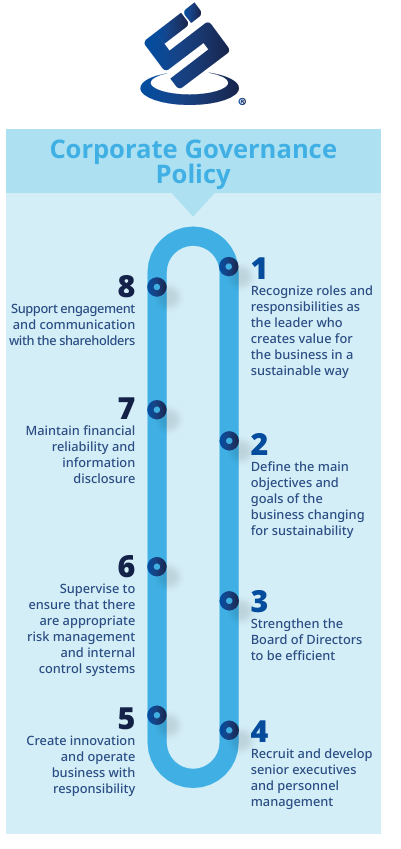
The Board of Directors has established the Company’s corporate governance policy in written form and regularly reviews and updates it on an annual basis to ensure its appropriateness in light of the evolving business context. The policy is consistently communicated throughout the organization to ensure that all employees understand and adhere to the established governance principles. The Company’s corporate governance policy can be summarized into the following eight key principles:
Policy Document Link

https://investor.sic.co.th/en/corporate-governance/corporate-governance-policy

Policy & Practices — Board of Directors

Introduction

The Board of Directors, as the highest governing body of the Company appointed by the shareholders and acting as their representative, plays a key role in overseeing the Company’s operations, allocating resources, supervising the performance of sub-committees, and determining the Company’s policies and business strategies. These responsibilities are carried out to ensure effective business operations, strong performance, and the creation of sustainable long-term value for the Company, thereby fostering confidence among shareholders, investors, and all stakeholders.

In performing its duties, the Board of Directors is required to act with responsibility, due care, and integrity, and to ensure that the Company’s operations are conducted in compliance with applicable laws and regulations, the Company’s Articles of Association, resolutions of the Board of Directors’ meetings, resolutions of shareholders’ meetings, and all relevant policies.

To support and enhance the effectiveness of the Board of Directors, the Company has established and regularly reviewed its corporate policies, as well as the charters of the Board of Directors and its sub-committees. In addition, the Board of Directors periodically reviews the Company’s vision, mission, and business strategies on an annual basis, and monitors the implementation of such strategies to ensure alignment with the Company’s corporate governance policy.

Has Policy & Guidelines for the Board

Yes

Board Guidelines

GuidelineOther — Please SpecifyDetailDocument Link
Nomination of Directors

The Company has established a systematic process for nominating and selecting suitably qualified individuals for appointment as directors. The Company has appointed the Nomination, Remuneration and Corporate Governance Committee to support the nomination and selection of qualified candidates through a transparent and well-defined process, taking into consideration the benefits of diversity in the composition of the Board of Directors.

In addition, the Company provides minority shareholders with the opportunity to propose qualified candidates for consideration for appointment as directors. This process aims to ensure that appointed directors possess qualifications in accordance with those specified in the Board of Directors’ Charter. Such qualifications include the absence of any prohibited characteristics as prescribed by law, appropriate knowledge, competencies, and experience beneficial to the Company’s business operations, the ability to exercise independent judgment from management, no engagement in businesses of a similar nature that compete with the Company, sufficient time to perform duties effectively, integrity and ethical conduct, a transparent professional background, and expertise from diverse fields that contributes to effective advice and oversight of the Company.

The Nomination, Remuneration and Corporate Governance Committee determines the required qualifications of directors to be nominated in alignment with the Company’s business strategies and direction. This is carried out through the preparation of a Board Skill Matrix to assess the composition and suitability of the current Board of Directors and to identify additional qualifications required in the future. The Committee then proposes the selected candidates, together with their profiles and relevant information, to the Board of Directors for consideration, prior to submitting the nominees to the shareholders’ meeting for approval of their appointment as directors, as appropriate.

Determination of Director Remuneration

The Company determines remuneration for the Board of Directors in the form of fixed monthly remuneration and meeting allowances paid on a per-meeting basis. With respect to the sub-committees, namely:

  1. The Audit Committee

  2. The Risk Management Committee

  3. The Nomination, Remuneration and Corporate Governance Committee

  4. The Executive Committee

For executives, the Company determines remuneration in the form of fixed monthly remuneration and variable remuneration based on the Company’s performance.

In addition, the Company has a policy to determine remuneration for the Board of Directors, sub-committee members, and executives at an appropriate level, both in monetary and non-monetary forms. In determining such remuneration, the Company considers the Company’s performance, scope of duties and responsibilities, individual performance, as well as remuneration levels comparable to those of businesses with similar characteristics. This is intended to incentivize the Board of Directors, sub-committees, and executives to jointly drive the Company toward achieving its objectives. All remuneration arrangements are required to be aligned with the Company’s strategies and business goals.

In this regard, the Nomination, Remuneration and Corporate Governance Committee reviews the appropriateness of each component of remuneration by establishing fair and reasonable remuneration criteria through a transparent review process, in order to enhance shareholders’ confidence. The Nomination, Remuneration and Corporate Governance Committee then proposes its recommendations to the Board of Directors for approval, prior to submitting them to the shareholders’ meeting for annual approval, as appropriate. Details of such remunerations for Board of Directors and all sub-committees are completely disclosed in the Company’s annual report (Form 56-1 One Report).

Independence of the Board of Directors from the Management

The Board of Directors places strong emphasis on maintaining its independence from management in order to ensure effective, transparent, and balanced corporate governance. The Board appoints a suitably qualified individual to serve as Chairman of the Board. In cases where the Chairman of the Board is not an independent director, the Board assigns at least one independent director to participate in the consideration and determination of the agenda for Board meetings, as well as to provide independent views on significant matters relating to policy formulation, oversight, and strategic decision-making of the Company.

Such practices are intended to promote an appropriate balance of power between the Board of Directors and management, reduce the risk of undue influence by management over the Board’s decision-making, and support the prevention and management of potential conflicts of interest. These measures also serve to protect the rights and interests of shareholders, investors, and all stakeholders. In this regard, the Board of Directors remains committed to ensuring that the Company’s corporate governance practices are aligned with the principles of good corporate governance for listed companies and in line with internationally recognized best practices.

Director Development

The Company encourages and facilitates the continuous development of knowledge, competencies, and skills of the Board of Directors by supporting their participation in training programs and seminars that are relevant and beneficial to the performance of their duties. Such programs include, for example, courses organized by the Thai Institute of Directors Association (Thai IOD), the Capital Market Academy (CMA), as well as development programs and seminars provided by the Office of the Securities and Exchange Commission and the Stock Exchange of Thailand, in addition to site visits to relevant factories or business partners, as appropriate.

In this regard, the selection of training programs and seminars is subject to the consideration and screening by the Nomination, Remuneration and Corporate Governance Committee. The Committee utilizes the Board Skill Matrix as one of the key tools to assess the composition, competencies, and suitability of the current Board of Directors, together with consideration of the roles, duties, and responsibilities of directors in each area, as well as the individual interests and development needs of each director. This process aims to ensure that director development is appropriate and aligned with the Company’s business direction, strategies, and operating context.

Furthermore, the Company Secretary Department plays an important role in supporting, coordinating, and encouraging directors by providing information on relevant and beneficial training programs and seminars, as well as facilitating their participation in such activities. This enables directors to effectively apply the knowledge and experience gained to corporate governance, policy formulation, and strategic decision-making. Such continuous development strengthens the effectiveness of the Board of Directors and enhances confidence among investors, shareholders, and all stakeholders that the Company maintains a sound, effective, and sustainable corporate governance framework.

Board Performance Evaluation

The Board of Directors requires that a performance evaluation of the Board be conducted at least once a year and assigns the Nomination, Remuneration and Corporate Governance Committee as the principal body responsible for overseeing the process. The purpose of the evaluation is to provide the Board of Directors with relevant information for assessing its performance and to support the continuous improvement and development of its duties. The performance evaluation of the Board of Directors is conducted in three forms, as follows:

  • a self-assessment of the Board of Directors as a whole;

  • a self-assessment of each sub-committee as a whole;

  • an individual self-assessment of directors and sub-committee members.

The Nomination, Remuneration and Corporate Governance Committee summarizes and analyses the evaluation results followed by the criteria, compares them with those of the previous year, and reports the outcomes to the Board of Directors for acknowledgement. The evaluation results are used as input for improving the Company’s operations in alignment with its business strategies, enhancing the effectiveness of collaboration among the Board of Directors and its sub-committees, and supporting the ongoing planning and development of the knowledge and skills necessary for directors.

Corporate Governance of Subsidiaries and Associated Companies

The Board of Directors is responsible for overseeing and ensuring that the Company’s subsidiaries, associated companies, or joint ventures conduct their business in compliance with the Securities and Exchange Act, notifications of the Capital Market Supervisory Board, and the relevant rules, regulations, and requirements of the Office of the Securities and Exchange Commission and the Stock Exchange of Thailand. This includes, but is not limited to, compliance with regulations relating to connected transactions, the acquisition or disposal of significant assets, and other laws applicable to the Company’s business operations. In this regard, the Board of Directors also monitors and ensures that subsidiaries and associated companies comply with the Company’s corporate governance policies, internal regulations, and investment governance guidelines in a consistent and appropriate manner.

With respect to the Company’s investment policy in subsidiaries, associated companies, or joint ventures, the Company considers investments that support and enhance its core business operations, are within industries with growth potential, or align with the Company’s expertise and capabilities. Such investments may also aim to acquire technology, distribution channels, or to mitigate risks within the value chain. In addition, the Company places importance on expected returns on investment, together with the sustainable growth of the Company.

In the case of investments in subsidiaries, the Company exercises oversight by appointing its representatives to serve as directors of such subsidiaries in proportion to its shareholding. Where a subsidiary undertakes transactions or business operations that may have a significant impact on the Company, the Company has established approval authorities requiring such matters to be submitted for approval by the Executive Committee or the Board of Directors, as appropriate, prior to execution.

Furthermore, the Company requires its appointed representatives to ensure that subsidiaries establish appropriate policies and procedures for connected transactions, the acquisition or disposal of assets, and other significant transactions, and that such transactions are conducted in full compliance with applicable requirements. Subsidiaries are also required to apply disclosure principles equivalent to those of the Company, and to maintain proper record-keeping and accounting systems to enable the Company to review such information and prepare consolidated financial statements accurately and on a timely basis.

For associated companies and joint ventures, the Company exercises oversight at an appropriate level in accordance with its shareholding by appointing its representatives to serve as directors. The extent of the Company’s involvement in the oversight and management of joint ventures is determined in accordance with the terms and conditions stipulated in the relevant agreements with joint venture partners.

https://investor.sic.co.th/en/corporate-governance/cg-report-and-download
Other guidelines regarding the board of directorsHolding Directorships in Other Companies

The Company has established policies and practices regarding the holding of directorships by its directors to ensure that the Board of Directors performs its duties effectively, transparently, and in accordance with the principles of good corporate governance. Directors of the Company may hold directorships in other companies, provided that such appointments do not impede the proper performance of their duties to the Company and are in compliance with the guidelines and requirements prescribed by the Office of the Securities and Exchange Commission and the Stock Exchange of Thailand.

In this regard, the Company requires that directors who hold directorships in other companies listed on the Stock Exchange of Thailand shall not, in aggregate, hold more than five directorships in listed companies. This limitation is intended to ensure that directors are able to devote sufficient time, knowledge, and expertise to the performance of their duties, exercise due care and independent judgment, and effectively oversee the Company’s operations in the best interests of the Company and all stakeholders.

Other guidelines regarding the board of directorsMeetings of the Board of Directors

The Board of Directors determines that meetings of the Board shall be held at least once in every quarter, or as circumstances and necessity may require. In the event that at least two directors request the convening of a Board meeting, the Company shall arrange such meeting within fourteen (14) days from the date of receipt of the request. In addition, the Company arranges meetings of non-executive directors without the presence of management in order to provide directors with an opportunity to exchange views independently, strengthen the balance between the Board and management, and promote appropriate good corporate governance practices.

The Company has appointed the Company Secretary Department to support the operations of the Board of Directors, including coordinating and facilitating compliance with resolutions of the Board of Directors, as well as managing matters relating to meetings of the Board of Directors and shareholders’ meetings. The Board of Directors works together with the Company Secretary Department in scheduling Board meetings and setting the meeting agendas in advance for the entire year. The Company Secretary Department informs directors of the annual meeting schedule and standard agendas in advance, starting from the end of the preceding year, to enable directors to appropriately allocate their time and attend meetings.

For each Board meeting, the Company Secretary Department is responsible for distributing the meeting notice, agenda, and supporting documents to the Board of Directors no less than seven (7) days prior to the meeting date, to allow directors sufficient time to review and consider the information thoroughly. The meeting agenda clearly specifies matters for acknowledgment, matters for consideration and approval, as well as the regular follow-up on the Company’s operating performance.

A quorum for a Board meeting requires the presence of not less than one-half of the total number of directors. In addition, the Company’s corporate governance policy stipulates that, at the time resolutions are passed, there must be not less than two-thirds of the total number of directors present at the meeting. Resolutions of the Board shall be passed by a majority vote. In the event that the votes are equal and no decision can be reached, the Chairman of the Board shall cast an additional vote as the deciding vote.

The Board of Directors may invite sub-committee members, executives, external auditors, or internal auditors to attend meetings, as appropriate, to provide information or opinions for consideration on relevant matters. In cases where any agenda item involves a particular director, such director who has an interest in the matter shall leave the meeting and abstain from voting on that agenda item, to ensure that decisions are made fairly, transparently, and in accordance with the principles of good corporate governance.

Policy & Practices — Shareholders and Stakeholders

Introduction

The Company is committed to conducting its business in parallel with creating sustainable value and benefits for shareholders and all stakeholders, guided by strong responsibility toward society, the environment, and good corporate governance as fundamental principles. The Company promotes operations that continuously enhance corporate value amid an ever-changing business environment, encompassing the determination of its business model, approaches to the design and development of products and services, research and development, improvements in production and operational processes, as well as collaboration with business partners and alliances throughout the value chain.

The Company is committed to conducting its business with integrity, transparency, and fairness as core values. It places importance on delivering high-quality services to customers, promotes fair competition, refrains from taking advantage of or engaging in any improper practices, and operates strictly within the framework of good governance principles.

In this regard, the Board of Directors recognizes the importance of the roles and expectations of each stakeholder group and is committed to treating all stakeholders in a transparent, appropriate, equitable, and fair manner. The Company’s key stakeholders include shareholders, employees, customers, trade partners, suppliers, creditors, government agencies, as well as communities and society. Accordingly, the Company has established appropriate policies, practices, and measures for each stakeholder group to build trust, foster constructive cooperation, and support the Company’s stable and sustainable long-term growth.

Has Policy & Guidelines for Shareholders and Stakeholders

Yes

Shareholder & Stakeholder Guidelines

GuidelineOther — Please SpecifyDetail
Shareholder

Shareholders’ Rights and Equitable Treatment of Shareholders

The Board of Directors places great importance on protecting shareholders’ rights and ensuring equitable, fair, and transparent treatment of all shareholders in accordance with the principles of good corporate governance. The Company aims to promote shareholders’ ability to fully exercise their fundamental rights and to participate appropriately in decision-making on significant matters of the Company. The Company recognizes shareholders’ fundamental rights, including:

  1. The right to buy, sell, or transfer shares;

  2. The right to a share of the Company’s profits;

  3. The right to receive sufficient relevant information and news through the Company’s website or the Stock Exchange’s website or by any other means;

  4. The right to attend meetings to exercise the voting rights at the shareholders’ meeting independently to appoint or remove directors, determine the remuneration of directors, appoint auditors, pay dividends, increase capital and issue new shares, as well as the right to question the Board of Directors about the report of the Board of Directors and any other matter presented to the meeting for consideration and approval. Moreover, the company shall ensure to facilitate and encourage shareholders, including institutional investors, to exercise their rights to attend and vote at the shareholders’ meetings equally.

  5. The right to propose the agenda in advance and to nominate persons for election to the Board of Directors and participation in decisions on important matters of the Company.

    Each shareholder is entitled to voting rights in proportion to the number of shares held, on the basis of one share, one vote.

    The Board of Directors is fully aware of and respects shareholders’ rights and shall not undertake any actions that may infringe upon or impair such rights. The Company ensures that shareholders’ meetings are conducted in an orderly, transparent, and efficient manner, enabling shareholders to exercise their rights effectively. In addition, the Company ensures proper and complete disclosure of shareholders’ meeting resolutions and accurate preparation of the minutes of shareholders’ meetings.


Promotion of Shareholders’ Rights and Equitable Treatment

Preparations Prior to the Shareholders’ Meeting

  • The Company convenes its Annual General Meeting of Shareholders (AGM) within four months from the end of the Company’s fiscal year, in accordance with the legally prescribed timeframe. The meeting is conducted in compliance with applicable laws, the Company’s Articles of Association, the regulations of the Stock Exchange of Thailand, and the principles of good corporate governance of the Securities and Exchange Commission. The Company does not schedule meetings on weekends or public holidays and determines appropriate dates, times, formats, and venues that are convenient for shareholders. Adequate personnel are arranged, and technology is applied to shareholder registration, vote counting, and result display to ensure that the meeting process is efficient, accurate, transparent, and verifiable. In this regard, the Company held the Annual General Meeting of Shareholders for the year 2025 on 25 April 2025 via electronic means (E-AGM), in compliance with the Emergency Decree on Electronic Meetings B.E. 2563 (2020), the Notification of the Ministry of Digital Economy and Society regarding the Security Standards for Electronic Meetings B.E. 2563 (2020), and other relevant laws and regulations. The Company engaged experienced and certified electronic meeting service providers, namely the certified Zoom Meeting system and the Inventech Connect voting system, which has passed a self-assessment of conformity by the Electronic Transactions Development Agency (ETDA). The meeting was recorded in audio and video format and broadcast live from the Townhall meeting room on the 3rd floor of the Company’s head office, with prior notification to shareholders in the meeting invitation.

  • The Company provides shareholders with the opportunity to submit questions, propose agenda items, and nominate candidates for election as directors in advance. For the Annual General Meeting of Shareholders for the year 2025, shareholders were invited to submit such proposals from 1 October 2024 to 31 December 2024. The relevant criteria were clearly disclosed on the Company’s website. After the submission period ended, the Company disclosed the results through the Company’s website and the Stock Exchange of Thailand’s information disclosure system. No shareholders proposed agenda items, questions, or director nominations in advance for the said meeting.

  • The Company discloses resolutions of the Board of Directors regarding the AGM date, meeting format, record date for determining shareholders entitled to attend the meeting, and meeting agenda through the Company’s website and the Stock Exchange of Thailand’s information disclosure system. The Company also publishes the meeting invitation and complete supporting documents, such as the minutes of the previous AGM, the Annual Report (Form 56-1 One Report), identity verification and meeting access instructions, voting procedures, proxy forms, and related documents, in both Thai and English on the Company’s website at least 30 days prior to the meeting date.

  • In addition, the Company sends the meeting invitation to shareholders by post at least 21 days in advance, together with complete supporting documents, clearly stating the objectives, rationale, and the Board of Directors’ opinions on each agenda item to allow shareholders sufficient time and information for consideration. The Company also publishes the notice of the meeting in newspapers for three consecutive days at least three days prior to the meeting date. No agenda items or material information are added or changed without prior notification to shareholders.


Conduct of the Shareholders’ Meeting

  • The Company facilitates shareholders’ full exercise of their rights to attend and vote at the meeting and refrains from any actions that may restrict shareholders’ participation. The Company provides an instructional video on meeting participation and voting procedures, prepares duty stamps for proxy forms, and arranges a call center to provide guidance and technical support. For the Annual General Meeting of Shareholders for the year 2025, shareholders were able to register in advance prior to the meeting start time and continuously until the meeting concluded. The Company also promotes the use of technology for shareholder registration, vote counting, and result display to enhance efficiency, accuracy, and timeliness of the meeting process.

  • The Company Secretary introduced the directors and executives attending the meeting, the auditors, and representatives of the external legal advisor responsible for supervising and verifying the vote counting process, ensuring transparency and compliance with applicable laws, the Company’s Articles of Association, and good corporate governance principles. The Company Secretary also reported the quorum to the meeting. At the opening of the AGM 2025, a total of 51 shareholders attended the meeting in person and by proxy via electronic means, representing 291,945,156 shares, or 60.8219% of the total issued and paid-up shares of 479,999,884 shares, constituting a quorum in accordance with Section 103 of the Public Limited Companies Act B.E. 2535 (1992) and the Company’s Articles of Association.

  • The Company Secretary reported the results of the advance submission of questions, agenda proposals, and director nominations to the meeting. Thereafter, the Chairman welcomed the shareholders and formally opened the meeting, which proceeded in accordance with the agenda specified in the meeting invitation. The Company informed shareholders of the collection, use, and disclosure of personal data, including still images, audio, and video recordings of meeting participants, for the purposes of recording, preparing meeting minutes, and meeting administration. The Chairman also explained the meeting procedures, rules, and guidelines prior to the consideration of each agenda item.

Meeting Procedures and Key Principle

  1. At the meeting, shareholders shall have voting rights equal to the number of shares they hold and/or represent by proxy, on the basis of one share, one vote.

  2. Each shareholder may cast only one type of vote such as Approve, Disapprove, or Abstain except for shareholders acting as custodians, who may split voting instructions.

  3. For agenda items relating to the appointment of directors to replace those whose terms have expired, the Company conducts the election on an individual basis, in line with good corporate governance principles.

Rules, Voting Procedures, Vote Counting, and Q&A

  1. The meeting considers matters in the order specified in the meeting notice. The Company presents information for each agenda item and provides shareholders with an opportunity to ask questions prior to voting. Voting results are announced after the vote counting for each agenda item is completed.

  2. Shareholders select the agenda item to vote on and click “Vote”. The system will display three voting options: “Approve”, “Disapprove”, and “Abstain.”

    1. For shareholders/proxy holders representing multiple shareholders, the system will display all represented names, and voting will be cast separately on an individual basis.

    2. To cancel a vote, shareholders may click “Cancel Vote.” If a shareholder does not cast a vote within the specified time, the Company will deem the shareholder to have voted “Approve” for such agenda item. Voting may be amended until the voting for that agenda item is formally closed. The Company allocates 1 minute for voting per agenda item. After the voting submission is closed, the Company will announce the results for that agenda item to the meeting.

  3. Where a proxy holder is appointed by multiple shareholders using the same email address and telephone number for identity verification, the system will consolidate the appointing shareholders under one user account. If different email addresses and/or telephone numbers are used, the system will not consolidate them, and separate user accounts will apply. To access another account, users may select “User Account” and click “Switch Account.” Switching accounts will not remove voting rights from the meeting’s voting base.

  4. If a shareholder logs out of the meeting before the voting for any agenda item is closed, the shareholder’s votes will not be counted as part of the quorum for that agenda item and will not be counted in the remaining agenda items immediately thereafter. However, leaving the meeting for any agenda item does not deprive the shareholder/proxy holder of the right to rejoin the meeting and vote on the agenda items that have not yet been processed in the system.

  5. For proxy forms where shareholders have provided specific voting instructions, the Company has already recorded the votes (Approve/Disapprove/Abstain) as instructed by the appointing shareholders during registration for voting on each agenda item.

  6. Before voting on each agenda item, the Company provides participants with an opportunity to ask questions or express opinions relevant to that agenda item. Participants select the relevant agenda item and click “Questions”. Two channels are available:

    1. Message: Participants may type their questions and click “Submit Question.” The Company will read and respond to relevant questions during the meeting. However, if a large number of questions are submitted, the Company reserves the right to select and manage questions as appropriate.

    2. Video Conference (VDO conference): Participants may click “Video Q&A” and then click “Confirm” to reserve a queue. The meeting operator will announce the name of the participant who is granted the opportunity to ask questions. The participant shall then turn on the microphone and camera. Before asking questions, the participant must state their full name and whether they are a shareholder or proxy holder, so that the Company can accurately record the information in the meeting minutes.

      The Company reserves the right to mute audio/video of any participant who uses inappropriate language, defames others, violates any laws, infringes on the rights of others, disrupts the meeting, or causes inconvenience to other participants.

  7. If a large number of shareholders wish to ask questions via video conference, in order to manage meeting time effectively, shareholders are requested to submit questions via message. The Company will respond via the meeting, during the closing session, or publish responses on the Company’s website, as appropriate.

  8. In the event shareholders experience issues with the meeting system or voting system, shareholders are advised to follow the instructions provided together with the meeting notice or select the “Help” menu in the system. Shareholders may also contact the Inventech Call Center via the telephone number and Line Official as displayed on the screen.

  9. In the event of a system disruption during the shareholders’ meeting, shareholders will receive an email with instructions to rejoin the meeting through a backup system.


  • The Company conducts voting by separately counting votes for each agenda item and provides shareholders with the opportunity to vote for the election of directors on an individual basis for the agenda item concerning the election of directors. In addition, during the consideration of each agenda item, the Chairman of the meeting provides shareholders with the opportunity to ask questions or express opinions prior to the voting.


Post-Meeting Procedures

  • After the Annual General Meeting of Shareholders for the year 2025, the Company disclosed the meeting resolutions through the Stock Exchange of Thailand’s information disclosure system within the meeting date and published the results on the Company’s website, clearly specifying attendance details and voting results (approval, disapproval, abstention, and invalid votes) for each agenda item.

  • The Company prepares complete minutes of the shareholders’ meeting in both Thai and English within 14 days from the meeting date and discloses them through the Stock Exchange of Thailand’s information disclosure system and the Company’s website, as well as submitting them to the Ministry of Commerce within the legally prescribed timeframe.

Employee

The Company recognizes employees as its key human capital, playing a vital role in the success and long-term sustainability of the organization. The Company is committed to providing a fair, safe, and supportive working environment that promotes continuous development, together with transparent and accountable management practices.

The Company’s remuneration and welfare management policy is based on performance, competencies, and responsibilities under clearly defined and measurable criteria. Compensation and benefits are regularly reviewed and appropriately adjusted in line with job roles and performance outcomes, with the aim of enhancing motivation, career stability, and employee engagement. Clear objectives, policies, and scopes of work are established and consistently communicated to employees through the use of key performance indicators (KPIs), performance evaluations, and internal communication channels, enabling employees to clearly understand their roles and actively contribute to driving the organization in the same direction.

In addition, the Company places strong emphasis on occupational health and safety by providing an appropriate working environment, necessary equipment, and adequate facilities. The Company also continuously promotes employee development and skills enhancement through both internal and external training programs, with appropriate allocation of resources. Furthermore, the Company respects employees’ rights and upholds fairness in the treatment of employees at all levels by providing channels for employees to express opinions, submit suggestions, or file complaints in cases of perceived unfair treatment, such as through the Human Resources Department, the Employee Welfare Committee, and the Whistle Blowing Channel. These measures aim to ensure transparency in operations and to foster trust and confidence among employees.

Customer

The Company aims to build long-term relationships and collaboration with customers based on integrity, honesty, reliability, and mutual trust. The Company is committed to achieving the highest level of customer satisfaction by responsibly addressing customer needs and concerns as a top priority, in accordance with business ethics and efficient service practices. The Company develops products and services with distinctive features, high quality, and compliance with relevant standards, with a focus on creating competitive advantages for customers. This is supported by systematic processes in product design, manufacturing, and quality control, together with effective cost management, enabling the Company to offer products at reasonable and competitive prices.

In terms of service delivery, the Company places importance on on-time delivery and service reliability through effective supply chain management. Continuous improvements are made to service processes to enhance customer satisfaction and overall customer experience. In addition, the Company encourages collaboration with customers in the development of new products to ensure that products and services respond effectively to customer requirements.

The Company conducts its business with responsibility toward society and the environment by establishing a clear code of business ethics and related practices as a guideline for operations and customer engagement. The Company also provides appropriate channels for customers to submit feedback, suggestions, and complaints, which are used as inputs for continuous improvement of products and services.

Furthermore, the Company places strong emphasis on the protection of customers’ personal data and strictly complies with its data protection policies and practices in accordance with the Personal Data Protection Act B.E. 2562 (2019), in order to enhance customer confidence and trust in the Company over the long term.

Business competitor

The Company places importance on conducting its business under the principles of fair competition, with integrity, transparency, and strict compliance with applicable laws, including trade competition laws. The Company refrains from any actions that may create unfair competitive advantages or distort market mechanisms. Employees at all levels are required to comply with the Company’s Code of Business Ethics and policies related to fair competition. The Company also communicates and promotes awareness among employees regarding fair competition principles, the avoidance of conflicts of interest, and respect for competitors’ rights, in order to ensure transparent and sustainable business operations.

In 2025, the Company did not encounter any disputes, complaints, or legal proceedings related to competitors, reflecting its commitment to fair competition and responsible business conduct toward all stakeholders.

Business partner

The Company treats its suppliers with integrity, fairness, and equality, aiming to build transparent and mutually beneficial business relationships that support long-term and sustainable cooperation. Supplier selection is conducted under clearly defined criteria, taking into account factors such as price, quality of products and services, reliability, ethical conduct, technical expertise, legal compliance, environmental protection, occupational health and safety, and social responsibility, in order to ensure effective operations and shared value creation. The Company manages supplier relationships in a systematic manner, covering procurement planning, cost management, and fair and timely payment practices. Effective communication and regular exchange of accurate and relevant information with suppliers are emphasized to enhance operational efficiency, reduce risks, and strengthen collaboration throughout the supply chain. In addition, the Company promotes continuous cooperation with suppliers in areas such as process improvement, quality enhancement, and new product development.

To ensure responsible and ethical business conduct, the Company has established a Supplier Code of Conduct as a guideline for suppliers, covering business ethics, compliance with applicable laws, respect for human rights, labor practices, occupational health and safety, environmental responsibility, and anti-corruption measures. The Company also conducts risk assessments, monitoring, and periodic reviews of supplier performance, as appropriate.

Furthermore, the Company provides appropriate channels for suppliers to submit feedback, suggestions, or complaints, including the Whistle Blowing Channel, to enhance transparency, accountability, and mutual trust. These practices support the development of strong, long-term partnerships with suppliers and contribute to growth throughout the supply chain.

Creditor

The Company places importance on building and maintaining good relationships with creditors based on integrity, reliability, and mutual trust. The Company fulfills its duties responsibly and strictly complies with all terms, conditions, and agreements entered into with creditors, in order to maintain confidence and long-term financial stability.

The Company manages its financial position and liquidity with discipline by planning and controlling debt repayment to ensure accuracy, completeness, and timeliness. Financial information is disclosed to creditors in an accurate, transparent, and sufficient manner, enabling creditors to appropriately assess the Company’s financial position and repayment capability. In addition, the Company emphasizes ongoing communication and coordination with creditors and is prepared to provide information, clarification, and consultation on any significant matters or changes that may affect financial arrangements. These practices aim to foster cooperation, mutual understanding, and sustainable business relationships with creditors over the long term.

Government agency

The Company places importance on conducting its business in strict compliance with applicable laws, rules, and regulations, and on interacting with government authorities and public sector organizations in a neutral, transparent, and fair manner. Such practices are guided by the Company’s Charter, Code of Business Ethics, Code of Conduct, Anti-Corruption Policy, and other relevant policies.

The Company has established clear processes and systems to ensure that communications, submissions, and reporting to government authorities are accurate, complete, and made within the prescribed timeframes. The Company also cooperates appropriately with government agencies by providing information, clarification, and compliance with regulatory requirements. In addition, the Company encourages constructive engagement with government authorities, where appropriate, to support the development of domestic industries, technology advancement, and local employment. The Company also closely monitors changes in relevant laws, regulations, and public policies and incorporates such developments into its business operations to ensure compliance and alignment with sustainable development principles.

Community and society

The Company conducts its business with responsibility toward communities, society, and resource utilization, taking into account potential impacts from its operations and striving to avoid or mitigate effects on the environment and surrounding communities. The Company treats communities with respect and friendliness and supports appropriate initiatives to enhance community well-being.

The Company promotes efficient and responsible use of resources and fosters employee awareness of sustainable practices. In addition, the Company supports the development of knowledge, technology, and human capital through collaboration with communities and educational institutions, including research and development activities, knowledge transfer, and internship programs, with the aim of creating shared value and supporting sustainable growth.

Other guidelines regarding shareholders and stakeholdersInnovation Promotion

The Board of Directors recognizes the importance of innovation as a key driver in creating value for the business and its stakeholders. The Company continuously emphasizes research and development (R&D) to integrate innovation into its products, enhancing customers’ competitiveness and supporting the Company’s sustainable growth.

In addition, the Company actively promotes an innovation ecosystem through collaboration with universities and research institutions. Key initiatives include delivering lectures and knowledge-sharing sessions on technology and innovation to students, organizing engineering competitions, providing internship and cooperative education opportunities, and offering guidance for undergraduate projects as well as graduate-level research. The Company also supports scholarships and research funding, and fosters collaboration with research laboratories to strengthen technological capabilities and human capital development in a sustainable manner.

In 2025, the Company received the SET Awards of Honor: Excellence as an Innovative Company 2023–2025, which recognizes companies that have consistently demonstrated excellence in innovation over a three-year period. In addition, the Company was awarded the Best Innovative Company Award for the third consecutive year, driven by its innovation SIC7150 (High-performance Low Frequency RFID Microchip). This high-performance RFID microchip, designed for livestock identification, is distinguished by its long reading range, low power consumption, and superior operational stability compared to market standards. The product has also been granted patents in Europe and the United States.

This achievement reflects the Company’s strong commitment to continuous innovation and reinforces its position as a technology leader. It is also aligned with the Company’s vision: “To create electronic devices for the world through intelligent innovation, connecting the world securely.”

Code of Conduct

Has a Business Code of Conduct

Yes

Code of Conduct Description

Silicon Craft Technology Public Company Limited places great importance on fair and equitable treatment of all stakeholder groups. The Company recognizes that cooperation in performing duties with integrity, ethical conduct, and adherence to ethical principles by directors, executives, and employees at all levels is a key factor in strengthening confidence and credibility in the long term, as well as driving the Company toward sustainable success.

With a strong commitment to conducting business in a standardized, efficient, and ethical manner in alignment with good corporate governance principles, the Company has established the “Code of Business Ethics and Code of Conduct” in written form. This Code serves as a guiding framework and operational standard for directors, executives, and employees at all levels. It covers business ethics principles, compliance with applicable laws and regulations, anti-corruption and anti-bribery practices, avoidance of conflicts of interest, safeguarding of the Company’s assets and information, as well as responsible, transparent, and fair treatment of stakeholders. The Code aims to foster a strong governance-based corporate culture and support the Company’s stable and sustainable long-term growth.

Business Ethics Principles

  • Adherence to the rule of laws

  • Transparency

  • Commitment to fairness and integrity

  • Customer focus

  • Social responsibility

  • Political neutrality

Code of Conduct Guidelines

  • Leadership qualities

  • Honesty and integrity

  • Compliance with laws and regulations

  • Asset management

  • Interaction with supervisors, colleagues, and subordinates

  • Good corporate citizenship

  • Avoidance of excessive gifts and benefits

  • Avoidance of conflicts of interest

  • Avoidance of improper use of confidential information


Whistleblowing, Suggestions, and Disciplinary Measures

  • Whistleblowing channels

  • Procedures for handling complaints

Code of Conduct Link

https://investor.sic.co.th/en/corporate-governance/cg-report-and-download

Code of Conduct Practices

GuidelineDetailDocument Link
Prevention of Misuse of Inside Information

The Company places great importance on good corporate governance and is committed to conducting its business with integrity, transparency, fairness, and accountability. Recognizing that the prevention of conflicts of interest is a key mechanism for protecting the interests of the Company, shareholders, and all stakeholder groups, the Company has established a Conflict of Interest Prevention Policy as part of its Code of Business Ethics and Code of Conduct. This policy serves as a guideline for directors, executives, and employees at all levels to perform their duties with the Company’s best interests as a priority and in strict compliance with applicable laws, rules, and regulatory requirements.

Key Practices

Directors, executives, and employees are required to avoid any actions or situations that may give rise to conflicts between personal interests and the interests of the Company. Key practices include the following:

  • Refraining from engaging in businesses of the same nature or businesses that compete with the Company, whether directly or indirectly, or from becoming a partner, controlling shareholder, director, or executive of any competing business, unless it can be clearly demonstrated that appropriate mechanisms are in place to ensure that such activities will not adversely affect the Company and are undertaken for the best interests of the Company and its shareholders as a whole.

  • Avoiding related party transactions with oneself and/or related persons that may give rise to conflicts of interest with the Company, and refraining from any actions that constitute the pursuit of personal benefits in violation of the Company’s ethics or code of conduct.

  • Not performing work for other companies or engaging in businesses other than those of the Company during working hours, and not undertaking any activities that compete with assigned duties or with businesses that compete with the Company, even outside working hours, including refraining from using any Company information under all circumstances, whether during employment or after termination of employment.

  • Disclosing and submitting information on personal interests and related persons in accordance with the prescribed requirements and strictly complying with the Company’s policy on related party transactions.

  • Not using business opportunities, positions, or Company information, including inside information, for personal gain or for the benefit of others, and strictly complying with the Company’s policy on the prevention of insider information misuse.

  • Strictly complying with the Company’s Code of Business Ethics and Code of Conduct, corporate governance policies, as well as applicable laws, rules, and regulatory requirements, including disclosure of information in accordance with the regulations of the Stock Exchange of Thailand and other relevant authorities.

  • Overseeing and ensuring that the Company maintains adequate, appropriate, and effective internal control systems, risk management systems, and anti-corruption mechanisms to ensure that all operations are conducted in compliance with applicable laws, regulations, and good corporate governance practices of listed companies.

In addition, the Company requires directors, executives, employees, and related persons such as family members or close associates; not to engage in any business or activities that may give rise to, or be perceived as giving rise to, conflicts of interest with the Company, whether directly or indirectly. Where any relationship or situation that may result in a conflict of interest exists, such individuals must promptly disclose such information in writing to their supervisors and the Company, and refrain from participating in the consideration or approval of the relevant transactions in order to avoid impropriety and to preserve independence in decision-making.

Disclosure and Oversight

The Company requires directors, executives, and major shareholders to disclose and report their interests and those of related persons on an annual basis and whenever there are changes, using the forms prescribed by the Company and submitting them to the Company Secretary for reporting to the Chairman of the Board. Any director or executive who has an interest in a matter under consideration must abstain from attending the meeting, deliberating, and voting on such matter, to ensure that the decision-making process remains independent and fair.

Furthermore, the Company requires directors and executives, including their spouses or partners living as husband and wife and their minor children, to notify the Company Secretary before or after the purchase, sale, transfer, or acquisition of the Company’s securities in accordance with the prescribed criteria, as well as to report any changes in securities holdings (Form 59) to the Securities and Exchange Commission when changes occur, in order to demonstrate transparency and accountability.

The Company continuously communicates its policies and practices on conflict of interest prevention to directors, executives, and employees, requiring them to review and acknowledge compliance on an annual basis. Relevant information is also disclosed through the Company’s communication channels. The Company further monitors, supervises, and evaluates compliance on an ongoing basis to ensure that its business operations adhere to good corporate governance principles and to enhance long-term confidence among stakeholders.

https://investor.sic.co.th/en/corporate-governance/cg-report-and-download
Anti-corruption

The Company is committed to conducting its business in accordance with the principles of good corporate governance and strict compliance with applicable laws and regulations. The Company upholds transparency, integrity, and accountability toward all stakeholders. In this regard, the Company does not accept or support corruption and bribery in any form, whether directly or indirectly.

To ensure that operations are carried out in a standardized and systematic manner and to continuously raise awareness among personnel throughout the organization regarding the importance of anti-corruption and anti-bribery practices, the Company has established an Anti-Corruption and Anti-Bribery Policy, together with related policies and guidelines. These include the Whistleblowing and Complaint Policy and the Policy on Giving or Receiving Gifts, Entertainment, and Business Hospitality, which are incorporated as part of the Business Ethics and Code of Conduct. The Board of Directors reviews the relevant policies on an annual basis and ensures that such policies are continuously communicated to and strictly observed by personnel at all levels across the organization.

Key Practices

  • Directors, executives, and employees are required to perform their duties with honesty, integrity, transparency, and fairness, and must refrain from any acts that constitute corruption, bribery, or violations of applicable laws, rules, regulations, and the Company’s policies.

  • Directors, executives, and employees must immediately report to the Board of Directors and the Audit Committee upon becoming aware of, or having reasonable grounds to suspect, any acts of corruption, bribery, violations of laws, or other irregular practices that may materially affect the Company’s reputation, financial position, or business operations, such as conflicts of interest, fraudulent acts, or significant deficiencies in internal controls.

  • Executives and employees must strictly comply with the Company’s procurement procedures, adhering to the principles of transparency, fairness, and auditability, and in accordance with the policies and procedures prescribed by the Company and in compliance with the Company’s prescribed rules and procedures.

  • The Company does not tolerate the solicitation, offering, or acceptance of bribes, or any other inappropriate benefits, whether directly or indirectly, from any stakeholders.

Oversight and Enforcement

Any violation of the Anti-Corruption and Anti-Bribery Policy shall be deemed a disciplinary offense and will be subject to appropriate disciplinary actions. Legal actions may also be taken where applicable. The Company has established appropriate whistleblowing channels and investigation processes, and provides protection to whistleblowers who report concerns in good faith, in order to ensure that business operations are conducted transparently, fairly, and in a verifiable manner.

https://investor.sic.co.th/en/corporate-governance/anti-fraud-policy
Whistleblowing and Protection of Whistleblowers

The Company is committed to conducting its business with integrity, transparency, and in accordance with the principles of good corporate governance. The Company places great importance on combating corruption in all forms. Accordingly, the Company has established a Whistleblowing or Complaint Policy regarding misconduct or corruption, together with clear guidelines on whistleblowing and complaint handling, including investigation procedures and whistleblower protection measures. This is to provide directors, executives, employees, subsidiaries, associates, and all stakeholder groups with appropriate channels to report information, complaints, or concerns regarding improper or unethical conduct in good faith and with confidence.

The Company has defined clear reporting channels and procedures for receiving complaints, investigating violations of the Code of Conduct, corruption, and other misconduct. Measures have also been put in place to protect whistleblowers, informants, complaint information, and related evidence by maintaining confidentiality, in order to prevent retaliation or unfair treatment.

Whistleblowing and Complaint Channels

Stakeholders may seek information, submit complaints, or report concerns regarding corruption, legal violations, inaccurate financial reporting, deficiencies in internal control systems, breaches of business ethics, personal data issues, or other misconduct through the following channels:

  1. By Post

    To: Chairman of the Board of Directors or the Chairman of the Audit Committee

    Silicon Craft Technology Public Company Limited

    40 Thetsabanrangsannua Rd., Ladyao, Chatuchak, Bangkok 10900 Thailand

  2. By Email

    1. The Audit Committee: ac@sic.co.th

    2. The Company Secretary Department: comsec@sic.co.th

  3. Via the Company’s Website http://www.sic.co.th/

  4. By Telephone 0-2589-9991


Scope of Whistleblowing or Complaints

Whistleblowers or complainants may report significant matters that could have a material adverse impact on the Company, including but not limited to the following:

  1. Illegal acts or non-compliance with policies on corporate governance, business ethics, or anti-corruption

  2. Violations of the Company’s rules, regulations, or internal policies

  3. Inaccurate financial reports, deficiencies in internal control systems, or falsification of financial documents

  4. Acts that constitute conflicts of interest

Procedures upon Receipt of a Complaint

  1. The complaint recipient shall collect relevant facts concerning violations or non-compliance with the Company’s business ethics and code of conduct.

  2. The facts shall be reported to management and/or independent directors and/or the Audit Committee, as appropriate, for consideration and investigation. The Company shall report whistleblowing information to the Audit Committee on a quarterly basis.

  3. The Audit Committee, which is independent from management, shall consider the matter and may order further actions or appoint a fact-finding committee to review complaints, determine appropriate, fair, and timely corrective measures, and ensure the protection of whistleblowers’ rights and confidentiality.

  4. Management, independent directors, or the Audit Committee shall inform the whistleblower of the investigation results if the whistleblower has disclosed their identity. In significant cases, the results shall be reported to the Chairman of the Board of Directors and/or the Board of Directors.

Whistleblower Protection

To build confidence among whistleblowers or complainants who act in good faith, the Company has established the following protection measures:

  1. The Company shall not disclose the name, address, or any information that could identify the whistleblower, except as required by law.

  2. Information, documents, and evidence related to the complaint shall be kept confidential and disclosed only to the extent necessary, with due consideration to the safety and potential impact on the whistleblower or related parties.

  3. Whistleblowers or complainants may request additional protective measures if they believe they may be subject to harm or adverse consequences.

  4. The Company shall provide appropriate and fair remedies to mitigate any damage suffered by affected persons.

  5. The Company shall not engage in any unfair treatment against whistleblowers or complainants, including changes in position, job duties, workplace location, suspension, intimidation, harassment, termination, or any other form of retaliation against whistleblowers, complainants, or those who cooperate in investigations

False or Malicious Reporting

If the Company determines that a whistleblowing report, complaint, statement, or information has been made with malicious intent, is false, or is intended to cause damage, the Company reserves the right to take disciplinary action and/or legal action against any person who deliberately provides false information or acts in bad faith to defame or cause harm to others or the Company.

https://investor.sic.co.th/en/corporate-governance/anti-fraud-policy
Preventing the Misuse of Inside Information

The Company recognizes the importance of conducting business with integrity and adherence to ethical standards. To ensure that shareholders, stakeholders, and investors receive accurate, timely, fair, and sufficient disclosure of information, the Company has established the Insider Information and Securities Trading Policy. This policy aims to prevent the misuse of inside or non-public information for improper personal gain and to promote fairness in the trading of the Company’s securities.

The Board of Directors oversees the formal adoption of this policy in writing and ensures that it is clearly communicated to and strictly observed by directors, executives, and relevant employees. Directors, executives, senior management in accounting or finance functions at manager level or above (or equivalent), as well as employees who have access to material inside information or information that may affect the price of the Company’s securities, are required to strictly comply with the laws governing securities and the capital market, as well as all related rules and regulations.

Key Practices

  1. Directors, executives, and employees are permitted to invest in the Company’s securities, provided that such transactions do not involve the use of inside information and do not give rise to any conflict of interest.

  2. Directors, executives, and employees who are aware of material inside information or information that may affect changes in the price of the Company’s securities, and which has not yet been disclosed to the Stock Exchange, are prohibited from using such information, whether directly or indirectly, to buy or sell the Company’s securities prior to public disclosure. This is to ensure transparency and fairness in securities trading. Such information includes, for example, information relating to mergers or acquisitions, the launch of new products, or other material financial information.

  3. Inside information of the Company must not be disclosed unless there is a legitimate reason and prior authorization has been obtained from the authorized persons of the Company.

  4. Directors, executives, and employees who know or may have access to the Company’s inside information must refrain from buying, selling, transferring, or receiving transfers of the Company’s securities during the period specified by the Company (the Blackout Period), namely one month prior to the disclosure of quarterly and annual financial statements and within 24 hours after such financial statements have been publicly disclosed, as well as any other periods as determined by the Company from time to time. Directors and senior executives are also required to report their securities trading and holdings to the Board of Directors.

  5. Directors, executives, and employees are required to strictly comply with the laws governing securities and the capital market, as well as all rules and regulations relating to the use of inside information. They must also maintain the confidentiality of information obtained in the course of their duties, including customer information, employee information, accounting and financial information, business plans, marketing plans, and any other information of economic value. Such information must not be disclosed, transferred, or used for personal benefit or for the benefit of others without proper authorization. All personnel are required to strictly comply with the Company’s Code of Business Ethics and Code of Conduct.

  6. The Investor Relations function has established a Silent Period of 14 days prior to the announcement of financial statements to the Stock Exchange of Thailand. During this period, no meetings, information provision, or commentary relating to financial statements will be given to analysts, investors, or shareholders, except for information that has already been publicly disclosed or factual clarifications of events that may affect the Company’s securities price.

Oversight of Securities Trading

The Company requires directors and senior executives, including their spouses or partners living as husband and wife, and their minor children, to comply with the guidelines for reporting the purchase, sale, transfer, or receipt of transfers of the Company’s securities, as follows:

  1. Directors and senior executives (including their spouses or partners and minor children) must notify the Company Secretary Department at least one day in advance prior to any purchase, sale, transfer, or receipt of transfer of the Company’s securities (where advance knowledge is available), or notify on the same day after the transaction has been executed.

  2. Directors and senior executives (including their spouses or partners and minor children) who engage in the purchase, sale, transfer, or receipt of transfer of the Company’s securities must submit Form 59 and Form 246-2 to the Office of the Securities and Exchange Commission (SEC) within three business days in accordance with SEC regulations.

  3. Directors and senior executives (including their spouses or partners and minor children) are required to report their securities transactions to the Board of Directors.

  4. The Company Secretary Department discloses changes in securities holdings of directors and senior executives in the Annual Report (56-1 One Report), showing the number of shares held at the beginning of the year, at year-end, and any changes during the year.

In addition, the Company recognizes that appropriate data governance and usage encompass both inside information related to the capital market and personal data of customers, employees, and stakeholders. Accordingly, the Company requires all personnel to strictly comply with policies relating to confidentiality and data usage in order to protect stakeholders’ rights, ensure equality and fairness among shareholders, and prevent the misuse of information for improper gain. At the same time, the Company places importance on providing education and raising awareness among directors, executives, and employees regarding the use of inside information and securities trading, to prevent the misuse of inside information for personal benefit or the benefit of others, which could result in unfairness to shareholders and stakeholders.

The Company has established disciplinary measures for violations of the policy on the use of inside information and securities trading, to ensure that business operations are conducted transparently, fairly, and in accordance with the principles of good corporate governance on a sustainable basis.

https://investor.sic.co.th/en/corporate-governance/cg-report-and-download
Giving or receiving gifts, entertainment, or business entertainment

The Company recognizes that the giving or receiving of gifts, entertainment, or business hospitality may pose risks related to corruption, conflicts of interest, or inappropriate business conduct. Therefore, the Company has established clear policies and guidelines to ensure that such practices are conducted appropriately, transparently, and in compliance with business ethics principles and good corporate governance.

The Company requires directors, executives, and employees at all levels to strictly comply with the policy on gifts, entertainment, and business hospitality. They must refrain from any actions that may be perceived as bribery, improper benefit-seeking, or the provision of undue advantages to themselves or others, whether directly or indirectly.

Key Practices

  • Directors, executives, employees, as well as their relatives or persons living in the same household, must not solicit, accept, or participate in social activities, sporting events, entertainment, hospitality, gifts, or other benefits for themselves or others from parties having business relationships with the Company, if such actions may influence business decision-making or result in inappropriate conduct.

  • In cases where it is unavoidable and consistent with customary practices or intended to promote legitimate business relationships, directors, executives, employees may accept gifts or benefits for business promotional purposes. In such cases, the value of the gifts or benefits must not exceed the threshold specified by the Company, which is not more than THB 3,000, and must be conducted in an open, transparent, and auditable manner. If the value of any gift or benefit exceeds THB 3,000, directors, executives, employees must immediately notify their supervisors in writing and submit the gift or benefit to the Company for consideration and further appropriate action.

  • In cases where directors, executives, employees represent the Company in attending business partner events, training programs, or off-site study visits, and receive gifts or benefits with a value exceeding THB 3,000, whether through lucky draws, raffles, or souvenirs, they must report such receipt in writing to their supervisors and submit the gifts or benefits to the Company accordingly.

https://investor.sic.co.th/en/corporate-governance/cg-report-and-download
Compliance with laws, rules and regulations

The Company places great importance on conducting its business in strict compliance with applicable laws, rules, and regulations, under the principles of good corporate governance, integrity, transparency, and accountability to all stakeholders. The Company recognizes that full and proper compliance with relevant legal and regulatory requirements is a fundamental basis for building trust, credibility, and sustainable long-term growth.

Accordingly, the Company requires directors, executives, and employees at all levels to study, understand, and strictly comply with all applicable laws, rules, regulations, notifications, and requirements of relevant regulatory authorities, as well as the Company’s internal policies, rules, and procedures. These principles are incorporated into the Company’s Code of Business Ethics and Code of Conduct, which are communicated to personnel on an ongoing basis to ensure consistent understanding and compliance throughout the organization.

Key Practices

  1. Directors, executives, and employees must perform their duties in compliance with applicable laws, rules, and regulations relevant to the Company’s business operations, including but not limited to laws governing securities and capital markets, labor laws, tax laws, personal data protection laws, and other laws relevant to their roles and responsibilities.

  2. All personnel must comply with the Company’s internal policies, rules, and procedures, including the Code of Business Ethics and Code of Conduct, and must not engage in any actions that may expose the Company to legal risks, reputational damage, or adverse financial impacts.

  3. Directors, executives, and employees must refrain from any acts that may constitute violations of laws, corruption, improper benefits, or conduct inconsistent with good corporate governance principles and the Company’s ethical standards.

  4. In cases of uncertainty or ambiguity regarding compliance with laws, rules, or regulations, personnel are required to consult their supervisors, relevant functions, or the Company Secretary to ensure that actions are taken in a lawful, prudent, and appropriate manner.

  5. The Company encourages the reporting of any violations or suspected violations of laws, rules, regulations, or ethical standards through its whistleblowing and complaint channels, with appropriate measures in place to protect whistleblowers acting in good faith.

Oversight and Enforcement

The Board of Directors oversees the Company’s compliance with laws, rules, and regulations in a systematic manner and assigns management to establish appropriate internal control systems, risk management processes, and monitoring mechanisms to prevent and mitigate compliance risks.

Any violations of laws, rules, regulations, or the Company’s policies shall be subject to disciplinary actions as appropriate and, where applicable, legal actions in accordance with relevant laws. These measures are intended to ensure that the Company’s operations remain transparent, fair, verifiable, and aligned with the principles of good corporate governance on a sustainable basis.

Use and maintenance of data and assets

The Company places great importance on the appropriate use and protection of its information and assets, recognizing that such information and assets are valuable resources and critical factors for efficient and sustainable business operations. Accordingly, the Company requires directors, executives, and employees at all levels to use, safeguard, and protect the Company’s information and assets responsibly and transparently, and in compliance with business ethics, applicable laws, as well as the Company’s policies and guidelines as stipulated in the Code of Conduct and internal work practices. This is to prevent any improper use of the Company’s information or assets or any actions that may cause damage to the Company and its stakeholders.

Key Practices

  1. Directors, executives, and employees shall use the Company’s assets solely for the benefit of the Company and strictly in accordance with work-related purposes. The use of the Company’s assets for personal benefit or for the benefit of others in an improper manner is strictly prohibited.

  2. Directors, executives, and employees shall properly safeguard and protect the Company’s assets against loss, damage, unauthorized use, or misuse that is contrary to applicable laws, regulations, and the Company’s policies.

  3. Directors, executives, and employees shall support efforts to obtain, protect, and maintain patents, copyrights, trademarks, and other intellectual property rights that are the property of the Company.

  4. Directors, executives, and employees shall comply with the Company’s Code of Conduct and internal work practices, including adherence to safety requirements relating to the use of equipment, tools, and the working environment.

  5. Directors, executives, and employees shall maintain the confidentiality of information obtained in the course of their duties, including customer information, employee information, accounting and financial information, sales and marketing data, business plans, project plans, and any other information of economic value. Such information shall not be disclosed, transmitted, or used for personal benefit or for the benefit of others without proper authorization.

  6. Directors, executives, and employees are prohibited from using inside information or non-public information of the Company to gain any improper advantage, whether directly or indirectly, both during their employment and after the termination of their employment with the Company.

Anti-competitive

The Company places great importance on the appropriate use and protection of its information and assets, recognizing that such information and assets are valuable resources and critical factors for efficient and sustainable business operations. Accordingly, the Company requires directors, executives, and employees at all levels to use, safeguard, and protect the Company’s information and assets responsibly and transparently, and in compliance with business ethics, applicable laws, as well as the Company’s policies and guidelines as stipulated in the Code of Conduct and internal work practices. This is to prevent any improper use of the Company’s information or assets or any actions that may cause damage to the Company and its stakeholders.

The Company conducts its business under the principles of fair and free competition, transparency, and strict compliance with applicable competition laws. The Company is committed to upholding business ethics and good corporate governance practices and does not support, tolerate, or engage in any conduct that may create unfair competition or take advantage of competitors, which could adversely affect the market, stakeholders, and the Company’s long-term credibility.

Key Practices

  1. Directors, executives, and employees must strictly comply with applicable competition laws, as well as the Company’s Code of Conduct and relevant policies, in all business activities.

  2. Participation in any conduct that may restrict, distort, or undermine fair competition is strictly prohibited, including but not limited to price fixing, market or customer allocation, or collusive arrangements with competitors.

  3. Directors, executives, and employees must not exchange, obtain, or disclose competitors’ confidential or sensitive business information, whether directly or indirectly, such as pricing, costs, business strategies, marketing plans, or any information that could result in an unfair competitive advantage.

  4. The use of inside information or information known only to a limited group within the Company for personal gain or to benefit others, or to obtain an unfair competitive advantage, is strictly prohibited.

  5. Directors, executives, and employees must avoid discussions or communications with competitors on matters that may affect fair competition, unless such interactions are lawful, appropriate, and necessary for legitimate business purposes, such as participation in industry associations, and must be conducted with due care without exchanging inappropriate information.

  6. The Company encourages competition based on quality, innovation, efficiency, and fair service to customers and business partners, without engaging in practices that exploit or cause harm to competitors.

  7. If directors, executives, or employees become aware of or suspect any conduct that may constitute unfair competition, they must promptly report the matter through the designated reporting channels, supervisors, or responsible units of the Company, so that appropriate, transparent, and fair investigations and corrective actions can be undertaken.

Cyber security

The Company Limited recognizes the importance of information security and information technology systems as fundamental enablers for efficient, transparent, and sustainable business operations. In this regard, the Board of Directors has established policies for information technology risk management and control to ensure that the allocation and utilization of information technology resources are appropriate, effective, and aligned with the Company’s corporate governance framework.

The Company places strong emphasis on safeguarding corporate information, personal data of stakeholders, and confidential business information against unauthorized access, use, disclosure, alteration, or destruction, whether arising from internal actions or external threats. Directors, executives, and employees at all levels are therefore required to use the Company’s information systems and information technology resources properly and responsibly, in compliance with applicable laws, regulations, and the Company’s policies, guidelines, and information security measures.

In addition, the Company has implemented appropriate controls and management measures for information and information technology security, with due regard to the confidentiality, integrity, and availability of information. The Company has also established a Business Continuity Plan (BCP) to support business continuity in the event of emergencies or crisis situations. These measures are designed to ensure operational stability, protect stakeholder interests, and support the Company’s long-term sustainable growth in accordance with the principles of good corporate governance.

Personal Data Protection Policy

The Personal Data Protection Act 2019 stipulates the protection of personal data in accordance with international standards. The company recognizes the importance of the protection of personal data and the restriction of the rights and freedoms of individuals; therefore, the personal data protection policy is established to provide a framework and guidelines for correct legal compliance and to be trusted by all customers, employees and stakeholders. The Company has appointed a personal data protection officer (DPO) to advise and monitor the operation of the personal data processor and related persons.

The scope of application of the policy covers all the Company’s operations related to the collection, disclosure, correction, alteration, or any other actions to personal data including the implementation of policies and guidelines regarding the protection of customer personal information in accordance with the Act. Protect personal information. The personal data protection policy is reviewed every 3 years or when there are changes, amendments, changes to related laws or regulations or changes according to the environment.

Collection, use, disclosure, and destruction of personal data

  1. The Company shall collect, use, and disclose personal data as necessary and appropriate under the objectives for the benefit of carrying out the Company’s mission. The Company must ask for consent from the data subject in collecting, using or disclosing personal data and arrange for the data subject to be notified on such matter or at the time of data collection, unless the provision of law on personal data protection or other related laws allow the Company to do otherwise. The request for consent must be made in writing or through an electronic system, except on the condition that the consent cannot be obtained by such means.

  2. The Company shall not collect personal data from sources other than the data subject directly without the consent of the data subject, unless exempted by law.

  3. The Company shall not collect personal data on race, ethnicity, political opinions, religious doctrine or philosophy, sexual behavior, criminal records, health data, disabilities, union information, genetic and biological data or any other similar information without the consent of the data subject, unless exempted by law.

  4. The Company shall record various transactions according to the law for inspection by the data subject and the Office of the Personal Data Protection Commission.

  5. The Company shall collect, use or disclose personal data in order to provide services in accordance with contractual obligations and relevant laws, rules, regulations, while increasing the efficiency of such services as deemed beneficial to the data subject.

  6. The Company shall not disclose personal data to third parties without the consent of the data subject, unless it is a disclosure required by law.

  7. The Company shall delete or destroy personal data or make the data non-identifiable to the data subject after the expiration of the storage period according to the Company’s order or the period specified in other relevant laws or when the data subject withdraws consent or opposes the collection, use or disclosure of data as permitted by law.

Security for personal data

  1. The Company shall provide appropriate security measures for personal data to prevent data loss, unauthorized access, destruction, use, alteration, modification, or disclosure of personal data without permission, and review measures when necessity or technological changes.

  2. The Company shall supervise the personal data processor to collect, use or disclose personal data with safety, according to relevant laws, rules, and regulations.

  3. In a bid to disclose personal data to other persons or juristic persons, the Company must prevent those persons from unauthorized or inappropriate use or disclosure of personal data.

  4. Provide an investigation process to perform deletion or destruction of data after the expiration of the storage period or upon the request or withdrawal of consent by the data subject.

  5. In case of a breach of personal data which is at risk of affecting the rights and freedom of individuals, the Company shall notify the personal data breach to the Office of the Personal Data Protection Commission within 72 hours from the knowledge of such incident. If the breach is at risk of affecting the rights and freedom of individuals, the data subject of personal data shall be notified without delay.

The rights of data subject of personal data

The data subject of personal data can exercise their rights as specified by law as follows:

  1. The right to request to access and obtain a copy of personal data or disclosure of the acquisition of data without the consent, which the Company must process within 30 days from the date of receiving such request.

  2. The right to object the collection, use or disclosure of personal data as permitted by law.

  3. The right to obtain or request for personal data to be sent or transferred to other persons for the purposes which the Company can manage with automatic tools or devices.

  4. The right to request deletion of personal data from the system or destruction or suspension or de-identification of the personal data of data subject unless in compliance with relevant laws.

  5. The right to request the correction of personal data to be accurate, current, complete, and not misleading.

  6. The right to withdraw previously given consent or to not allow personal data to be collected, used, disclosed, except as required by law.

  7. The right to request for suspension of personal data use as permitted by law.

All stakeholders can contact the Company’s Data Protection Officer (DPO) at privacy@sic.co.th.

Environmental management

The Company recognizes that environmental management is an integral part of responsible business operations and sustainable development. The Company is committed to minimizing environmental impacts arising from its operations, production processes, and supply chain, while promoting efficient and responsible use of resources.

In this regard, the Company has established its approach under the Code of Business Ethics and Code of Conduct, the Corporate Social Responsibility Policy, and the Sustainability Development Policy. These frameworks emphasize compliance with applicable laws, efficient resource utilization, waste reduction, and responsible business practices in collaboration with stakeholders, with due consideration for environmental impacts.

Key Practices

  1. Directors, executives, and employees at all levels shall perform their duties with due consideration for environmental impacts, alongside social responsibility and ethical business conduct.

  2. Strict compliance with applicable environmental laws, regulations, standards, and the Company’s internal policies and requirements is required.

  3. Resources shall be utilized efficiently and responsibly, including promoting energy conservation and responsible resource consumption in daily operations.

  4. Continuous efforts shall be made to reduce waste and minimize environmental impacts arising from operations and production processes.

  5. Environmental risks and impacts associated with business activities shall be assessed and monitored, with appropriate preventive and mitigation measures in place.

  6. The Company promotes responsible business practices with customers, business partners, and stakeholders, and supports environmentally friendly practices throughout the supply chain.

  7. Environmental awareness and responsibility shall be fostered among employees to ensure effective implementation in day-to-day operations.

  8. Environmental performance shall be continuously monitored, reviewed, and reported to enhance the effectiveness of the Company’s environmental management.

Human rights

The Company has established a standalone Human Rights Policy to clearly articulate its commitment and framework for respecting human rights across its operations and value chain, in alignment with applicable national laws and internationally recognized standards.

In parallel, the Company integrates human rights principles into its Code of Business Ethics and Code of Conduct, which serves as a practical guideline for directors, executives, and employees in their day-to-day operations. These principles include fair and non-discriminatory treatment, respect for human dignity, and the provision of grievance mechanisms and whistleblower protection.

The combined implementation of the Human Rights Policy and the Code of Conduct enables the Company to promote respect for human rights in a systematic manner, covering both policy-level commitments and operational practices. This approach supports good corporate governance principles and contributes to the Company’s sustainable growth over the long term.

Occupational health and safety

The Company places great importance on occupational health and safety, recognizing that employees are a key driving force for sustainable business operations. Directors, executives, and employees at all levels are therefore required to perform their duties with due care and responsibility, in accordance with the Code of Business Ethics and Code of Conduct, in order to prevent workplace accidents, injuries, and health-related risks.

The Company provides a safe and appropriate working environment in compliance with applicable laws and relevant standards, and promotes awareness of occupational health and safety through communication, training, and adherence to established guidelines.

These practices form part of the Company’s commitment to fostering a culture of safety, responsibility, and respect for the life and well-being of its personnel, supporting efficient operations and long-term sustainable growth.

Key Practices

  1. Directors, executives, and employees at all levels shall perform their duties with due care and responsibility, taking into account the safety of themselves and others at all times.

  2. Strict compliance with applicable laws, regulations, and occupational health and safety standards is required.

  3. The Company shall provide a safe and appropriate working environment to support employees’ operations.

  4. Equipment, tools, and Company assets shall be used properly and safely.

  5. Risks shall be assessed and controlled, with preventive measures in place to minimize accidents, injuries, and work-related hazards.

  6. Employees are encouraged to report accidents, near-miss incidents, or unsafe conditions in order to enable continuous improvement and prevention.

  7. Emergency response measures and preparedness plans shall be established, with regular drills conducted.

  8. The Company promotes employees’ health and well-being, both physically and mentally.

  9. Occupational health and safety performance shall be continuously monitored, reviewed, and improved to enhance effectiveness.

Promoting Compliance with the Code of Conduct

Promotes Compliance by Directors, Executives and Employees

Yes

Description

The Company continuously communicates and promotes awareness of the Code of Business Ethics and Code of Conduct. Directors are required to review the Code, the Company Charter, and relevant policies through the Board of Directors’ annual review agenda, with company-wide enforcement, to ensure that corporate governance practices remain appropriate and up to date. Meanwhile, the Human Resources Department requires executives and employees to regularly review the Code through training videos, assessments based on Company-defined criteria, and annual acknowledgements.

In addition, the Company has integrated business ethics and code of conduct content into its orientation program for new employees to instill awareness of integrity, responsibility, and ethical behavior from the commencement of employment, thereby systematically cultivating an ethical corporate culture.

In 2025, the Company’s directors, executives, and employees reviewed their understanding of the Code of Conduct and business ethics, with a total participation rate of 99.47% of all personnel. The details are as follows:

1

Directors

Total of 7 persons, representing 100%
All directors reviewed the Company’s Code of Conduct, charters, and relevant policies, and approved the revision of the Code of Conduct at the Board of Directors’ Meeting No. 4/2025 held on 17 July 2025.

2

Executives

Total of 5 persons, representing 100%
All executives acknowledged and passed the assessment on business ethics and Code of Conduct, with a minimum passing score of 70% as determined by the Human Resources Department.

3

Employees

Total of 178 persons, representing 99.44%
The majority of employees acknowledged and passed the assessment on business ethics and Code of Conduct, using the same evaluation criteria as for executives, with a minimum passing score of 70%.

The Company continuously monitors and evaluates compliance with the Code of Conduct and has established disciplinary measures and complaint handling procedures in cases of non-compliance. Relevant committees and functions are responsible for providing appropriate oversight to ensure that the Company’s operations are conducted with transparency, fairness, and accountability, and in alignment with good corporate governance principles, thereby enhancing confidence among shareholders and all stakeholders.

Anti-Corruption Networks & Projects

Joined or Declared Intent to Join Anti-Corruption Networks

No

Networks & Projects Joined

Network / Project
Thai Private Sector Collective Action Against Corruption: CAC
United Nations Global Compact (UNGC)
Participation of anti-Corruption networks and initiatives

Material Changes & Developments in CG

Reviewed the CG Policy or Board Charter in the Past Year

Yes

Material Changes or Developments in the Past Year

Yes

Policy Review — Description

In 2025, the Company conducted a comprehensive annual review and revision of its corporate policies, Board charters, and Code of Business Conduct to ensure alignment with good corporate governance principles as prescribed by the Securities and Exchange Commission (SEC) and the Stock Exchange of Thailand (SET). The Board of Directors’ Meeting No. 4/2025, held on 17 July 2025, approved such revisions accordingly. Currently, the Company maintains a total of eight Board charters, one Code of Business Conduct, and twenty-two corporate policies. All sub-committee charters have been reviewed by the respective sub-committees prior to being proposed to the Board of Directors for further consideration and approval in due course.

During the year, key revisions were made to the Charter of the Nomination, Remuneration, and Corporate Governance Committee, particularly in relation to the enhancement of roles and responsibilities, the establishment of annual performance evaluation requirements for the Committee, and improvements to meeting practices to enhance effectiveness. Other policies and charters did not undergo material changes and were reviewed to ensure they remain up to date and fit for purpose. In this regard, the Company has incorporated the results of such evaluations into the continuous improvement of relevant charters and governance practices.

In addition, the Board of Directors emphasized strengthening governance oversight to ensure clarity, transparency, and accountability in operations. The Board approved enhancements to processes and approval authorities in areas such as procurement, disbursement, and budget management, with the aim of improving operational efficiency, enhancing clarity of delegation of authority, and mitigating operational risks, as part of the Company’s governance and risk management framework.

The Board of Directors also reviews the Company’s strategy, vision, and mission on an annual basis. Management is required to present strategic plans and regularly report progress on long-term strategic initiatives to the Board, enabling continuous monitoring of execution. This includes the establishment of Key Performance Indicators (KPIs) and structured monitoring mechanisms, allowing the Company to effectively track performance and adjust strategies in alignment with evolving business directions. In 2025, the Company organized the Board Strategy 2026 session during 5-7 September 2025 at Atta Lakeside Resort Suite, Khao Yai, to define future business directions and support the effective execution of strategic initiatives.

These efforts reflect the Company’s strong commitment to continuously enhancing its corporate governance framework by maintaining clear, up-to-date, and fit-for-purpose policies and charters, together with active strategic oversight and systematic monitoring, which serve as a key foundation for the Company’s sustainable growth.

Implements the CG Code for Listed Companies

No

CG Code — Description

The Company recognizes that good corporate governance is a fundamental mechanism for enhancing transparency, credibility, and long-term sustainable growth. The Corporate Governance Code for Listed Companies 2017 (CG Code) has been adopted as a guiding framework for the Company’s business operations, with appropriate application in alignment with the Company’s size, business nature, and operational context.

The Company has established a clear corporate governance framework, comprising corporate governance policies, Board and Board Committee charters, and the Code of Business Ethics and Code of Conduct. These serve as guiding principles for directors, executives, and employees at all levels, covering key areas such as the roles and responsibilities of the Board, strategic direction setting, risk management and internal control, ethical conduct, and fair treatment of stakeholders.

The Board of Directors performs its oversight role in supervising and monitoring the Company’s operations to ensure alignment with its strategies and objectives. The Board convenes regularly, reviews management performance, and carefully considers and approves significant matters within its authority, ensuring that the Company’s operations are conducted efficiently, transparently, and in an accountable manner.

In terms of strategic direction, the Board reviews the Company’s strategy, vision, and mission on an annual basis. A structured strategic oversight mechanism has been established, whereby management is required to present strategic plans and report progress on key initiatives to the Board on a regular basis. This includes the use of Key Performance Indicators (KPIs) and systematic monitoring processes, enabling the Board to effectively evaluate performance and adjust strategies in response to changing business environments.

The Company places strong emphasis on ethical business conduct and accountability. Directors, executives, and employees are required to adhere to the Code of Business Ethics and Code of Conduct, with continuous communication, awareness-building, and monitoring to foster a corporate culture grounded in integrity, responsibility, and transparency. With respect to risk management and internal control, the Company has established appropriate systems overseen by the Audit Committee and the Risk Management Committee. These committees play key roles in supervising, monitoring, and providing independent recommendations to ensure that the Company operates in compliance with applicable laws and regulations, while effectively managing risks.

The Company has also implemented a whistleblowing mechanism to provide channels for employees and stakeholders to report improper conduct or misconduct transparently. Appropriate measures are in place to protect whistleblowers and maintain confidentiality, along with systematic follow-up and oversight of reported matters.

In terms of disclosure and stakeholder communication, the Company ensures that information is accurate, complete, and timely. The Investor Relations function is responsible for communicating with shareholders, investors, analysts, and other stakeholders on an equitable basis, including disclosures through the Annual Report, Form 56-1 One Report, and the Company’s website.

In summary, the Company has implemented the CG Code in a systematic manner through a well-defined governance framework, active strategic oversight, and continuous monitoring processes. This reflects the Company’s commitment to enhancing corporate governance standards and supporting sustainable and resilient growth in the long term.

Other CG Performance & Outcomes

  • The Company achieved a full score of 100 in the Annual General Meeting (AGM) quality assessment conducted by the Thai Investors Association (TIA), reflecting transparency, completeness, and due regard for shareholders’ rights.

  • The Company was selected as one of the ESG100 companies for 2025 by Thaipat Institute, marking its third consecutive year of inclusion. This reflects the Company’s outstanding performance in Environmental, Social, and Governance (ESG) practices.

  • The Company participated in the FTSE Russell ESG assessment for 2025 and achieved an overall ESG score of 3.9 out of 5.0, classified as Good Practice. Notably, the Company received the highest score of 5.0 in the Corporate Governance pillar, reflecting the strength of its governance framework.

  • The Company received a “A” rating (maintained) in the SET ESG Ratings 2025, with a score of 71, an improvement from the previous year, demonstrating continuous ESG development.

  • The Company was rated 5-star “Excellent” in the Corporate Governance Report (CGR) by the Thai Institute of Directors (IOD) for the fourth consecutive year, reflecting a high standard of corporate governance practices.

  • The Company received a sustainability assessment score of 66 from EcoVadis, placing it in the 75th percentile, which reflects its performance against international ESG standards.

  • The Company was included in the ThaiESG List, a government-supported ESG label promoting investment in sustainable companies.

  • The Company received recognition at the SET Awards 2025, including:

    • Awards of Honor under the Innovative Company Awards category

    • Outstanding Investor Relations Awards for the fourth consecutive year, reflecting excellence in investor communication and stakeholder engagement

Contents