

CG Structure · 2025
In this section24 topics
- Board Composition9 items
- Board of Directors1 item
- Board Meetings & Remuneration5 items
- Directors Who Left During the Year1 item
- Balance of Power Between the Board and Management3 items
- Board Roles, Duties and Charter3 items
- Other Board Governance Matters1 item
- Subcommittees — Overview1 item
- Audit Committee5 items
- Executive Committee5 items
- Executives2 items
- Executive Remuneration5 items
- Remuneration Policy3 items
- Employees3 items
- Employee Remuneration2 items
- Provident Fund4 items
- Policy for Employees Not in the Provident Fund4 items
- Auditors and Audit Fees3 items
- Company Secretary and Other Assigned Persons7 items
- Investor Relations Contact3 items
- Representatives in Thailand (Foreign Companies)1 item
- Audit Committee Members Who Left During the Year1 item
- Executive Committee Members Who Left During the Year1 item
- Other Subcommittees — Members Who Left During the Year1 item
Board Composition
Board Composition — Introduction
The Board of Directors plays a key role in driving the organization, with duties to establish business strategies, policies, and operational plans, as well as to oversee management to ensure that operations are conducted in accordance with the Company’s objectives and in a manner that maximizes value for shareholders, while taking into account the interests of all stakeholders under good corporate governance principles. The Board is required to perform its duties with transparency, accountability, prudence, integrity, and honesty, and to ensure that the Company’s operations are in compliance with its objectives, Articles of Association, resolutions of the Board of Directors and shareholders’ meetings, as well as applicable laws, rules, and regulations.
The Board recognizes the importance of diversity in its composition and has established a Board Diversity Policy to ensure fair and non-discriminatory consideration of Board composition. The Board comprises qualified individuals with diverse skills, gender, age, educational background, knowledge, experience, and areas of expertise that are beneficial to the Company’s business and aligned with its strategic direction.
The Board has also developed a Board Skill Matrix to support business growth and the long-term success of the organization, without limitation or discrimination in terms of gender, race, nationality, religion, or other factors. In 2025, the Board Diversity details are summarized as follows:
No. | Key Indicator | Target | Achievement |
1 | Number of Independent Directors | At least one-third of the total number of directors, and not less than 3 persons | 3 persons |
2 | Audit Committee member with financial expertise | At least 1 person | 1 person |
3 | Number of female directors | At least 1 person | 2 persons |
4 | Non-executive director with relevant industry experience | At least 1 person | 3 persons |
The current Board structure is appropriate and ensures an effective balance of power in governance. The Board comprises at least one-third independent directors, with a minimum of three independent directors. In addition, the Company has established an Audit Committee consisting of at least three independent directors, all of whom possess qualifications in accordance with the requirements of the Securities and Exchange Commission (SEC), the Stock Exchange of Thailand (SET), as well as relevant notifications, rules, and regulations.
The Audit Committee includes at least one member with sufficient knowledge and experience to review the reliability of financial statements, and at least one non-executive director with relevant industry experience.
The Company has appointed a non-executive director as Chairman of the Board. The Chairman and the Chief Executive Officer are not the same person, in line with good corporate governance principles, thereby ensuring an appropriate balance of power between the Board and management, as well as enabling clear and effective oversight of management performance.
In addition, none of the Company’s directors holds directorships in more than five listed companies.
Composition of the Board of Directors
The Board of Directors consists of not less than five directors, and not less than half of the total number of directors shall be resident in the Kingdom, and not less than three-quarters of the total number of directors must have Thai nationality. The appointment of the Board of Directors must be approved by the shareholders’ meeting.
The Board of Directors consists of independent directors of at least one-third of the total number of directors, but there must not be less than three individuals, provided that the independent directors have full qualifications according to the announcement of the Capital Market Supervisory Board and relevant announcements by the SET.
The directors shall have a term of office of 3 years at a time. At every annual general meeting, one-third of the directors shall be removed from office. If the number of directors to be retired cannot be divided into the whole numbers, the number shall be as close as possible to the proportion of one-third. The directors who have already left office may be re-elected. The directors who shall retire in the first and the second years after the Company’s registration shall be drawn through lots. For following years, the directors who are in the position the longest shall retire. The directors who retire under that term may be re-elected.
In addition to the end of a term of office, the directors shall retire upon:
Resignation
The shareholders’ meeting has a resolution to leave the position (with a minimum of three-quarters of the number of shareholders present and entitled to vote)
Lack of qualifications and having prohibited attributes required by law
Death
In case the position of director becomes vacant for any reason other than the end of an office term, the directors shall select a person who is qualified and does not have prohibited qualifications under Section 68 of the Public Limited Companies Act B.E. 2535 (1992) and/or relevant laws to become a substitute director at the next meeting of the Board of Directors. Unless the remaining term of the director is less than 2 months, the person becoming the substitute director shall remain as a director for as long as the remaining term of the directors he/she represents and shall obtain a resolution of the Board of Directors by not less than three-quarters of the votes of the remaining directors.
The appointment of the Board of Directors must be approved by the shareholders’ meeting in compliance with the criteria and process as follows:
One shareholder has one vote per share.
Shareholders vote to elect directors individually.
Individuals with the highest number of votes in descending order are elected as directors equal to the number of directors that should be or shall be elected at that time. In case that the those elected in descending order have the same number of votes exceeding the number of directors that should be or shall be elected at that time. The Chairman shall have the final vote.
Total Number of Directors
7
Male Directors
5
Female Directors
2
Independent Directors
3
Non-executive Directors
5
Non-executive Directors Who Are Not Independent
2
Executive Directors
2
Total Board Meetings Held
7
Board of Directors
Directors
| Title | First Name | Last Name | Gender | Year of Birth | Nationality | Resident in Thailand? | Position | Executive or Non-executive | Independent Director? | Director Type | Appointment Date | Authorised to Sign? | Related to Another Director or Executive? | Any Legal Violation in the Past 5 Years? | Highest Education | Field of Study | Skills & Expertise | Director Training | Attended Director Training? | Director Accreditation Program (DAP)? | Director Certification Program (DCP)? | Board Meetings Held | Board Meetings Attended | AGMs Held | AGMs Attended | Meeting Allowance (Baht) | Other Remuneration (Baht) | Total Remuneration (Baht) | Non-monetary Remuneration | Shares Held | Shareholding (%) | Shares Held by Related Persons (s.59) | Shareholding by Related Persons (s.59, %) | Indirect Shareholding (held by whom) |
|---|---|---|---|---|---|---|---|---|---|---|---|---|---|---|---|---|---|---|---|---|---|---|---|---|---|---|---|---|---|---|---|---|---|---|
| Mr. | Apinetr | Unakul | M | 1,968 | 643 · Description: Thailand | Y | Chairman of the board | Non-executive | N | Existing director | 2019-04-05T00:00 | N | N | N | Master's degree | Engineering | 159 · Description: Engineering · 164 · Description: Strategic Management · 150 · Description: IT Management · 165 · Description: Risk Management · 265 · Description: Governance/ Compliance | 1731 · Year: 2017 · Description: Director Certification Program (DCP) · 1730 · Year: 2024 · Description: Director Accreditation Program (DAP) · 1733 · Year: 2016 · Description: Ethical Leadership Program (ELP) · 3186 · Year: 2025 · Description: ESG in the Boardroom: A Practical Guide for Board (ESG) · 2016 · Description: Anti-Corruption Practical Guide (ACPG) · 2023 · Description: Corporate Governance for Executives (CGE) | Y | Y | Y | 7 | 7 | 1 | 1 | 95,000 | 0 | 95,000 | 1 | 78,032,620 | 16.26 | |||
| Ms. | Supattana | Ngimhoung | F | 1,980 | 643 · Description: Thailand | Y | Director | Non-executive | Y | Newly appointed director to replace the ex-director | 2025-04-26T00:00 | N | N | N | Master's degree | Business Administration | 1683 · Description: Business Administration · 143 · Description: Accounting · 144 · Description: Finance · 164 · Description: Strategic Management · 165 · Description: Risk Management | 1731 · Year: 2020 · Description: Director Certification Program (DCP) · 1730 · Year: 2020 · Description: Director Accreditation Program (DAP) · 2025 · Description: Anti-Corruption Practical Guide (ACPG) | Y | Y | Y | 5 | 5 | 0 | 0 | 50,000 | 240,000 | 290,000 | 1 | 0 | 0 | |||
| Mr. | Wuthipong | Suponthana | M | 1,965 | 643 · Description: Thailand | Y | Director | Non-executive | Y | Existing director | 2019-04-05T00:00 | N | N | N | Doctoral degree | Engineering | 159 · Description: Engineering · 165 · Description: Risk Management · 1683 · Description: Business Administration · 164 · Description: Strategic Management · 265 · Description: Governance/ Compliance | 1731 · Year: 2025 · Description: Director Certification Program (DCP) · 1730 · Year: 2017 · Description: Director Accreditation Program (DAP) · 1735 · Year: 2022 · Description: Risk Management Program for Corporate Leaders (RCL) · 1740 · Year: 2024 · Description: The Board’s Role in Mergers and Acquisitions (BMA) · 2021 · Description: Anti-Corruption the Practical Guide (ACPG) · 2023 · Description: Corporate Governance for Executives (CGE) | Y | Y | Y | 7 | 7 | 1 | 1 | 70,000 | 360,000 | 430,000 | 1 | 300,000 | 0.06 | |||
| Mrs. | Vilawan | Mangklatanakul | F | 1,964 | 643 · Description: Thailand | Y | Director | Non-executive | Y | Newly appointed director to replace the ex-director | 2025-04-26T00:00 | N | N | N | Doctoral degree | Law | 141 · Description: Law · 265 · Description: Governance/ Compliance · 164 · Description: Strategic Management · 158 · Description: Corporate Management · 147 · Description: Sustainability | 1730 · Year: 2025 · Description: Director Accreditation Program (DAP) · 2025 · Description: Director’s Briefing 4/2025: ESG Risk Mitigation — What Directors Need to Know Before Risks Become Organizational Turning Points | Y | Y | N | 5 | 5 | 0 | 0 | 50,000 | 240,000 | 290,000 | 1 | 0 | 0 | |||
| Mr. | Naiyavudhi | Wongkomet | M | 1,971 | 643 · Description: Thailand | Y | Director | Non-executive | N | Existing director | 2019-04-05T00:00 | Y | N | N | Doctoral degree | Engineering | 159 · Description: Engineering · 163 · Description: Leadership · 164 · Description: Strategic Management · 165 · Description: Risk Management · 265 · Description: Governance/ Compliance | 1731 · Year: 2022 · Description: Director Certification Program (DCP) · 1730 · Year: 2017 · Description: Director Accreditation Program (DAP) · 1739 · Year: 2022 · Description: Successful Formulation & Execution of Strategy (SFE) · 1740 · Year: 2023 · Description: The Board’s Role in Mergers and Acquisitions (BMA) · 3280 · Year: 2025 · Description: Board’s Roles in Purpose-driven Transition (PDT) · 2021 · Description: Corporate Governance for Executives (CGE) · 2025 · Description: Director Forum 2025 for the topic of Future-Ready Boards: Board Nomination and Compensation Strategies | Y | Y | Y | 7 | 7 | 1 | 1 | 70,000 | 0 | 70,000 | 1 | 31,915,320 | 6.65 | 16,795,848 | 3.5 | K Investment Limited holds 16,795,848 shares (3.50%). K Investment Limited is a juristic person incorporated in Hong Kong, with shareholding held equally by Ms. Aiyanuch Wonkomet (50.00%) and Ms. Aiyanuch Wongkomet (50.00%). |
| Mr. | Apinunt | Thanachayanont | M | 1,973 | 643 · Description: Thailand | Y | Director | Executive | Existing director | 2019-04-05T00:00 | Y | N | N | Doctoral degree | Engineering | 157 · Description: Project Management · 159 · Description: Engineering · 161 · Description: Design · 164 · Description: Strategic Management · 265 · Description: Governance/ Compliance | 1731 · Year: 2023 · Description: Director Certification Program (DCP) · 1730 · Year: 2017 · Description: Director Accreditation Program (DAP) · 1739 · Year: 2022 · Description: Successful Formulation & Execution of Strategy (SFE) · 1737 · Year: 2023 · Description: Strategic Board Master Class (SBM) · 1740 · Year: 2024 · Description: The Board’s Role in Mergers and Acquisitions (BMA) · 3186 · Year: 2025 · Description: ESG in the Boardroom: A Practical Guide for Board (ESG) · 2022 · Description: Corporate Governance for Executives (CGE) | Y | Y | Y | 7 | 7 | 1 | 1 | 0 | 0 | 0 | 1 | 23,646,555 | 4.93 | ||||
| Mr. | Bodin | Kasemset | M | 1,975 | 643 · Description: Thailand | Y | Director | Executive | Existing director | 2021-04-30T00:00 | Y | N | N | Doctoral degree | Engineering | 159 · Description: Engineering · 163 · Description: Leadership · 164 · Description: Strategic Management · 1683 · Description: Business Administration · 158 · Description: Corporate Management | 1731 · Year: 2022 · Description: Director Certification Program (DCP) · 1730 · Year: 2020 · Description: Director Accreditation Program (DAP) · 1739 · Year: 2021 · Description: Successful Formulation & Execution of Strategy (SFE) · 1740 · Year: 2022 · Description: The Board’s Role in Mergers and Acquisitions (BMA) · 1737 · Year: 2022 · Description: Strategic Board Master Class (SBM) · 1728 · Year: 2025 · Description: Board Nomination and Compensation Program (BNCP) · 2021 · Description: Boardroom Success through Financing & Investment (BFI) · 2021 · Description: Corporate Governance for Executives (CGE) | Y | Y | Y | 7 | 7 | 1 | 1 | 0 | 0 | 0 | 1 | 14,768,911 | 3.08 |
Board Meetings & Remuneration
Date of the Annual General Meeting
2025-04-25T00:00
Was an Extraordinary General Meeting Held?
No
Board Meeting Allowance (Baht)
405000.0
Other Board Remuneration (Baht)
1080000.0
Total Board Remuneration (Baht)
1485000.0
Directors Who Left During the Year
Directors Who Left During the Year
| Title | First Name | Last Name | Gender | Year of Birth | Nationality | Resident in Thailand? | Position | Executive or Non-executive | Independent Director? | Appointment Date | Date of Leaving | Authorised to Sign? | Related to Another Director or Executive? | Any Legal Violation in the Past 5 Years? | Highest Education | Field of Study | Field of Study — Please Specify | Attended Director Training? | Director Accreditation Program (DAP)? | Director Certification Program (DCP)? | Board Meetings Held | Board Meetings Attended | AGMs Held | AGMs Attended | Meeting Allowance (Baht) | Other Remuneration (Baht) | Total Remuneration (Baht) | Non-monetary Remuneration | Shares Held | Shareholding (%) | Indirect Shareholding (held by whom) |
|---|---|---|---|---|---|---|---|---|---|---|---|---|---|---|---|---|---|---|---|---|---|---|---|---|---|---|---|---|---|---|---|
| Mr. | Manop | Dhamsirianunt | M | 1,966 | 643 · Description: Thailand | Y | Chairman of the board | Non-executive | N | 2019-04-05T00:00 | 2025-04-26T00:00 | Y | N | N | Master's degree | Engineering | Y | Y | Y | 2 | 2 | 1 | 1 | 30,000 | 0 | 30,000 | 1 | 102,604,212 | 21.38 | Shareholding Structure in the Company (as of 31 December 2024) | |
| Mrs. | Monluedee | Sookpantarat | F | 1,964 | 643 · Description: Thailand | Y | Director | Non-executive | Y | 2019-04-05T00:00 | 2025-04-26T00:00 | N | N | N | Master's degree | Accounting | Y | Y | Y | 2 | 2 | 1 | 1 | 20,000 | 120,000 | 140,000 | 1 | 480,000 | 0.1 | Shareholding Structure in the Company (as of 31 December 2024) | |
| Mr. | Sarote | Phornprapha | M | 1,967 | 643 · Description: Thailand | Y | Director | Non-executive | Y | 2016-04-05T00:00 | 2025-04-26T00:00 | N | N | N | Doctoral degree | other | Education Management (Organizational Behavior) | Y | Y | Y | 2 | 2 | 1 | 1 | 20,000 | 120,000 | 140,000 | 1 | 600,000 | 0.13 | Shareholding Structure in the Company (as of 31 December 2024) |
Balance of Power Between the Board and Management
Are There Measures Balancing the Board's and Management's Power?
Yes
Measures Balancing the Board's and Management's Power
The Company has established appropriate measures to ensure checks and balances between the Board of Directors and management, in order to promote effective, transparent, and accountable corporate governance. The roles and responsibilities of the Board and management are clearly segregated, whereby the Board is responsible for setting policies, strategic direction, and overseeing operations, while management is responsible for day-to-day operations in accordance with the established policies.
The Company has appointed a non-executive director as Chairman of the Board, and the positions of Chairman of the Board and Chief Executive Officer are held by different individuals. This structure supports an appropriate balance of power and helps mitigate the risk of concentration of authority. In addition, the Company has established an Audit Committee comprising independent directors to review the adequacy and effectiveness of the internal control system, risk management, and financial reporting processes, as well as to monitor compliance with applicable laws and regulations. The Audit Committee regularly reports its findings to the Board of Directors.
The Company requires that any director who has a conflict of interest in a particular matter abstains from voting on such matter. The Company has also established robust procedures for the approval of related party transactions, which require review by the Audit Committee and/or independent experts, as appropriate.
Furthermore, the Board of Directors is provided with accurate, complete, and timely information to support its decision-making. The Company Secretary plays a key role in facilitating the Board’s activities and coordinating independently between the Board and management.
Methods Used to Balance Power
| Method | Other — Please Specify |
|---|---|
| Other | Governance Mechanisms between the Board of Directors and Management |
Board Roles, Duties and Charter
Does the Company Have a Board Charter?
Yes
Content of the Board Charter
Charter of the Board of Directors
Objective
The Board of Directors, as the highest governing body of the Company, is appointed by the shareholders and acts as their representative. The Board plays a crucial role in overseeing the Company’s operations, formulating policies and strategies, and ensuring that management effectively implements such policies and strategies in a manner that aligns with the Company’s vision, mission, and strategic direction, while creating the greatest benefit for shareholders and all stakeholder groups.
In performing its duties, the Board of Directors is required to act with responsibility, prudence, integrity, and honesty, and to ensure that the Company’s operations are conducted in compliance with applicable laws, the Company’s Articles of Association, resolutions of the Board of Directors and shareholders’ meetings, as well as relevant policies. This is to ensure strong operating performance and the sustainable creation of long-term value for the Company.
Material authorities, Duties, and Responsibilities of The Board of Directors
The Board of Directors shall therefore perform its duties with responsibility, carefulness, and integrity, as well as supervise the Company’s operation in accordance with the laws, regulations, resolutions of the meetings of the Board of Directors and the Shareholders and the relevant policies of the Company as identified from the following details.
To have power and duties pursuant to the Company’s articles of association, as well as to oversee and manage the operations of the Company to ensure compliance with the laws, objectives, articles of association of the Company and the resolutions of shareholders’ meetings;
To specify the Company’s vision, mission, target, strategy and policy;
To approve the significant strategies, policies, objectives and targets with regards to business operations, assets management, finance, fund raising, investments and risk management of the Company as well as to follow-up on efficiently compliance with the specified plans;
To consider the matters which are required to propose to the shareholders for consideration and approval during the shareholders’ meeting. Main agenda during the annual general meeting of shareholders are:
To consider the report of the Board on the Company’s performance proposed to the meeting;
To consider and approve the financial statements;
To consider on allocation of the Company’s profits;
To propose a list of new director to replace the director who shall retire by rotation;
To nominate an auditor and fix the auditor’s remuneration;
To consider any transaction which may have conflict of interest, in the part which is required to request for approval from the shareholders;
Other matters.
To prepare the report on general information and financial information of the Company in order to report to the shareholders and the stakeholders or the general investors correctly, on timely manner and pursuant to the applicable laws;
To acknowledge important audit report of the Audit Committee or the supervisory agency and the internal audit unit as well as the auditor and the consultants of the Company and to specify guidelines on improvement or correction, in case material defects have been found;
To specify clear and appropriated operating guidelines in order to make internal control system transparently and effectively;
To review adequacy and appropriateness of the Company’s internal control system and risk management system;
To arrange the succession plan continually;
To consider and evaluate performance of the Board of Directors and the sub-committees as well as supervise the Company to ensure that it has efficient process for evaluation performance of the top management;
To appoint the Audit Committee and to give comment on power and duties of the Audit Committee;
To appoint the representative to oversee the subsidiary, the associated company or the joint venture;
To consider and specify management structure, power to appoint the Executive Committee, the President and other sub-committees, as appropriated, as well as to specify scope of power and duties of the Executive Committee, the President and the sub-committees appointed to assist and support operations of the Board;
However, the delegation of authority pursuant to the specified scope of power and duties shall not be in the manner which can entitle the Executive Committee, the President and the subcommittees consider and approve any transactions which may have interests or other conflict of interests against benefits of the Company or the subsidiary (if any), unless it is the approval of transaction which conforms to policy and criteria already considered and approved by the Board of Directors;
To consider, define and amend name of the directors authorized to sign and bind the Company;
To authorize one or more directors or any person to act on behalf of the Board. However, the abovementioned authorization shall not include the delegation of authority which can entitle such authorized person to approve any undertaking that such person or a person who might have conflict of interest (the definition of “a person who might have conflict of interest” shall be as per defined in the notification of the Securities and Exchange Commission), interests or any benefits in any other manners against benefits of the Company;
However, the following undertakings shall be exercised only after they have obtained an approval from the shareholders’ meeting first, provided that, any director or any person who might have any conflicts, interests or conflict of interest regarding any transaction with the Company and/or its subsidiary shall not have the right to vote for such transaction:
Any matter that the laws has specified that it must have an approval from the shareholders’ meeting;
Any transaction that any director may have some interests and in scope that the laws or regulations of the Stock Exchange of Thailand prescribed that it must have an approval from the shareholders’ meeting;
In addition, the following activities are required to have approval with majority votes from the Board of Directors’ meeting presenting at the meeting and from the shareholders’ meeting with the votes not less than three fourths (3/4) of votes of shareholders present at the meeting and have the voting rights:
Disposition or transfer of total or some material parts of the Company’s businesses to other persons;
To enter into, amend or revoke the contract concerning rental of total or some material parts of the Company’s businesses;
The assignment of other person to manage business of the Company or merger of the other’s business for profit sharing purpose;
Issuance of new securities to repay to the Company’s creditors pursuant to debt to equity conversion project;
Registration to decrease the Company’s registered capital by reducing the number of shares or devaluation of shares;
Increase, decrease, issuance of debentures, merger or dissolution of the Company;
Other matters, as per specified by the laws.
A transaction that the director or the person authorized by the director or the person who might have any conflicts, interests or conflict of interest regarding any transaction with the Company or its subsidiary, shall not have the right to vote on such matter.
In addition, the Board shall have duties to oversee and ensure that the Company shall comply with the laws on securities and exchange, requirements of the stock exchange, such as connected transactions, acquisition and disposition of assets pursuant to criteria of the Stock Exchange of Thailand or as per the notification of the Securities and Exchange Commission, the Capital Market Supervisory Board or the laws relevant to the Company’s businesses.
Link to the Board Charter
https://investor.sic.co.th/en/corporate-governance/cg-report-and-download
Other Board Governance Matters
Board Governance Practices
| Practice | Yes / No |
|---|---|
| The chairman of the board and the highest-ranking executive are from the same person | N |
| The chairman of the board is an independent director | N |
| The chairman of the board and the highest-ranking executive are from the same family | N |
| Chairman is a member of the executive board or taskforce | N |
| The company appoints at least one independent director to determine the agenda of the board of directors’ meeting | N |
Subcommittees — Overview
Roles of the Subcommittees — Introduction
Structure and composition of sub-committees
The Board of Directors elected four Sub-Committees to support the company’s good corporate governance and facilitate the company’s business as follows:
The Audit Committee
The Risk Management Committee
The Nomination, Remuneration and Corporate Governance Committee
The Executive Committee
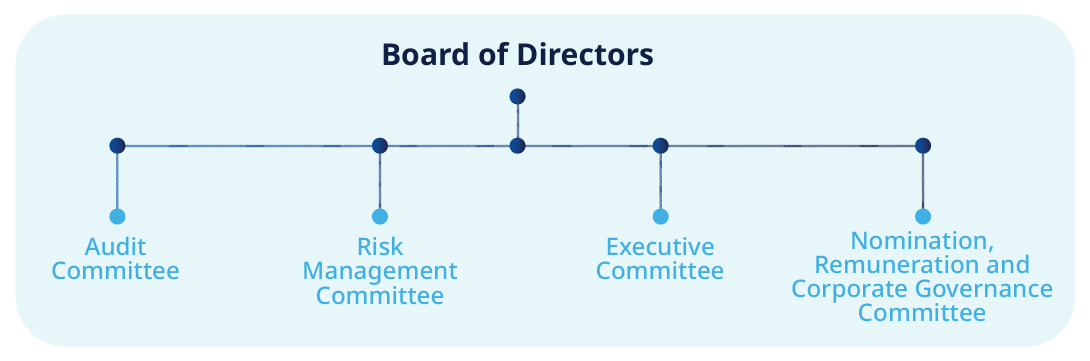
Audit Committee
Audit Committee Charter
| Roles, Duties and Responsibilities | Type of Subcommittee | Link to the Charter |
|---|---|---|
Objective
The Audit Committee is a sub-committee of the Board of Directors which was appointed to help ease the Board of Directors' mission in its operations and to provide the business with a good corporate governance. The Audit Committee was established to enhance the efficiency of operations and value-added to the organization in various areas as follows.
1. Confidence and reliability, as well as transparency of the Company’s financial reports
2. Increased awareness of the performance of the Board of Directors' duties. The Audit Committee shall take into account on its responsibilities as follows.
2.1. Financial reporting
2.2. Choosing the right accounting policy
2.3. Financial Management
2.4. Internal control system and internal audit
2.5. Consideration of the independence of the internal auditors and/or third-party internal auditors, as well as the evaluation of the work of the head of internal auditors and/or the third-party internal auditor
2.6. Compliance with relevant requirements and laws
2.7. Business Risk Management and Control
2.8. Recommendation of appointment and evaluation of the performance of the certified auditors
3. Allow the Board of Directors to consider in depth in other matters other than financial reporting and internal control systems and increase efficiency in other areas of management
4. Strength in the role and authority of external directors
5. Strengthen the directors' understanding of the scope of the audits that have been determined
In order to perform the duties of the Audit Committee, the Committee must maintain a working relationship with the Board of Directors, executives, as well as external auditors and internal auditors of the Company to ensure efficient operation. Each audit committee member needs to develop and maintain expertise and knowledge as well as understanding of responsibilities and understanding of the Company's business and damages.
Material authorities, Duties, and Responsibilities of The Audit Committee
1. To review accuracy and adequacy of the Company’s financial reporting by coordinating with the external auditor and the executives who are responsible for preparing of quarterly and yearly financial reports. The Audit Committee may recommend the auditor to review or audit any transaction which it deems necessary and materially during the Company’s auditing process;
2. To review the Company’s internal control system and internal audit jointly with the external auditor and the internal auditor to ensure that they are suitable and efficient, to determine independence of the internal audit unit and/or the outsourced internal auditor, including to approve the appointment, transfer and dismissal of the chief of the internal audit unit and/or the outsourced internal auditor;
3. To review the Company’s compliance with the laws on securities and exchange, regulations of the stock exchange and the laws pertaining to the Company’s businesses;
4. To select and propose an independent person to be the Company’s auditor and to fix his/her remuneration based on creditability, adequacy of resources and amount of auditing work of such auditing firm, including the experiences of the personnel assigned to perform the Company’s audit works, as well as to attend the meeting with the auditor without any participation of the Company’s Management at least once a year;
5. To consider the connected transactions or transactions that may lead to conflicts of interest to ensure their compliance with the laws, notifications and regulations of the Stock Exchange of Thailand and the Capital Market Supervisory Board to make sure that such transactions are reasonable and for the best interests of the Company.
6. To consider transactions on acquisition or disposition of the Company’s assets of which transaction size is required to obtain approval from the Audit Committee as per specified in the laws, notifications, regulations of the Stock Exchange of Thailand and criteria of the Office of the Securities and Exchange Commission and the Capital Market Supervisory Board.
7. To prepare the Audit Committee’s report and disclose in the Company’s annual report. Such report must be signed by the Chairman of the Audit Committee and at least it must contain the following information:
- Recommendation on accuracy, completeness and creditability of the Company’s financial report;
- Recommendation on adequacy of the Company’s internal control system;
- Recommendation on compliance with the laws on securities and exchange, regulations of the Stock Exchange of Thailand, or laws related to the Company’s businesses;
-Recommendation on suitability of the auditor;
- Recommendation on transaction which may have conflict of interest;
- Number of the Audit Committee’s meetings arranged and attendance of such meetings by each committee member;
- Overall recommendations or observations that have arisen while the Audit Committee performed its duties in accordance with the Charter;
- Other matters which should be made available to the shareholders and general investors within scope of duty and responsibilities assigned by the Company’s Board of Directors.
8. The Audit Committee shall conduct self-evaluation on its performance and report such evaluation results together with problems or obstacles found in performing the works which may make them unable to achieve objectives as per specified to the Board for acknowledgement every year;
9. To approve the internal audit plan, as well as to consider on acknowledgement of performance report of the Internal Audit Unit and/or the outsourced internal auditor;
10. To consider, review and improve the Audit Committee Charter and propose to the Board for consideration and approval;
11. In carrying out duties, if the Audit Committee has found or is suspicious about any of the following transactions or activities which may have material impacts to the financial position or performance of the Company, the Audit Committee must report the Board of Directors to take corrective action within a period of time it deems appropriated. Such transaction include:
Recommendation on accuracy, completeness and creditability of the Company’s financial report;
- Transaction with the conflicts of interests;
- Fraud or unusual transaction or significant deficiency in the Company’s internal control system;
- Violation or breach of laws on securities and exchange, notifications and regulations of the Stock Exchange of Thailand and the laws related to the Company’s business.
12. To conduct an investigation of the matter notified by the Company’s auditor. If the Company’s auditor discovered any suspicious circumstance concerned with the director, manager or any person responsible for the Company’s operations, which can be regarded as the fraudulent act as per specified in the Securities and Exchange Act and the auditor has reported such issue to the Audit Committee, the Audit Committee must conduct an investigation and shall report the result of the preliminary investigation to the Office of Securities and Exchange Commission and the auditor within 30 days from the date notified by the auditor.
13. To perform any other tasks as assigned by the Board of Directors and approved by the Audit Committee.
In performing the operations pursuant to the scope of authority and duty, the Audit Committee shall have power to invite or order the concerned management, the department head or the employee of the Company to provide recommendation, participate in the meeting or submit document which is deemed relevant and necessary. Moreover, in performing duties under scope of authority and duty of this regulation, the Audit Committee may consult with the external independent consultant or the expert in various professions, if it deems necessary and appropriated, at the Company’s expenses. | 3091 · Description: Audit of financial statements and internal controls | https://investor.sic.co.th/en/corporate-governance/cg-report-and-download |
Audit Committee Members
| Title | First Name | Last Name | Position | Gender | Year of Birth | Nationality | Resident in Thailand? | Appointment Date | Highest Education | Field of Study | Has Accounting or Financial Expertise? | Skills & Expertise | Meetings Held | Meetings Attended | Meeting Allowance (Baht) | Other Remuneration (Baht) | Total Remuneration (Baht) | Non-monetary Remuneration |
|---|---|---|---|---|---|---|---|---|---|---|---|---|---|---|---|---|---|---|
| Ms. | Supattana | Ngimhoung | Chairman of the audit committee | F | 1,980 | 643 · Description: Thailand | Y | 2025-04-26T00:00 | Master's degree | Business Administration | Y | 1683 · Description: Business Administration · 143 · Description: Accounting · 144 · Description: Finance · 164 · Description: Strategic Management · 165 · Description: Risk Management | 4 | 4 | 80,000 | 0 | 80,000 | 1 |
| Mr. | Wuthipong | Suponthana | Audit committee | M | 1,965 | 643 · Description: Thailand | Y | 2019-04-05T00:00 | Doctoral degree | Engineering | N | 159 · Description: Engineering · 165 · Description: Risk Management · 1683 · Description: Business Administration · 164 · Description: Strategic Management · 265 · Description: Governance/ Compliance | 6 | 6 | 60,000 | 0 | 60,000 | 1 |
| Mrs. | Vilawan | Mangklatanakul | Audit committee | F | 1,964 | 643 · Description: Thailand | Y | 2025-04-26T00:00 | Doctoral degree | Law | N | 141 · Description: Law · 265 · Description: Governance/ Compliance · 164 · Description: Strategic Management · 158 · Description: Corporate Management · 147 · Description: Sustainability | 4 | 4 | 40,000 | 0 | 40,000 | 1 |
Audit Committee — Meeting Allowance (Baht)
240000.0
Audit Committee — Other Remuneration (Baht)
0.0
Audit Committee — Total Remuneration (Baht)
240000.0
Executive Committee
Executive Committee Charter
| Roles, Duties and Responsibilities | Type of Subcommittee | Link to the Charter |
|---|---|---|
Material authorities, Duties, and Responsibilities of The Executive Committee
1. To have power to make decision on important operations of the Company by specifying scope, type or size of business, objectives, guideline and policy of the Company within the scope of power assigned including to supervise overall operations, productivity, relationship with the customers as well as to be responsible for the Board;
2. To oversee and manage the Company’s business operations pursuant to the policy specified by the Board of Directors and to report operating results to the Board;
3. To formulate strategy and business operation plan, annual budget including management structure so that the works can be undertaken pursuant to the policy and target specified by the Board, as well as to propose to the Board for consideration;
4. To specify approval authority of each person appropriately, segregate duties which may be prone to corruption then propose to the Board for approval then supervise to ensure that the approved principles and regulations have been adhered to;
5. To have power to manage salary structure, to specify scope of duty on work, appointment, transfer, wages cutting or reduction, removal, dismissal, disciplinary penalty, awarding and merit of the employees;
6. To consider on approval of financial transactions with the bank or the financial institutes to support normal course of business operations, such as opening or closing of bank account, loan, borrowing, credit line financing, pledge, mortgage, guarantee and etc., including purchase, sale and register for ownership in any land for normal course of business operation pursuant to the approval power approved by the Board of Directors;
7. To consider on investment, work expansion as well as acquisition and disposition of the Company’s fixed assets to propose to the Board;
8. To have power to act and represent the organization with the third party in the activities related to and beneficial to the organization;
9. To consider about the Company’s fund raising activity to propose to the Board;
10. To approve on appointment of consultants in various fields necessary for business operations;
11. To manage general business of the Company;
12. To consider and approve operation plans of each department and consider and approve the requested application of any department which exceeds power of such department;
13. To jointly work with the Risk Management Committee on formulation of risk management policy and risk appetite to propose to the Board;
14. To jointly work with the Risk Management Committee to specify overall risk management policy and guidelines of the Company covering various material types of risks, i.e. financial risk, investment risks and risks which may impact to the business’s reputation, and etc. to propose for the Board’s approval;
15. To jointly work with the Risk Management Committee to specify the Company’s risk management plan, framework and process to make them consistent with the risk management policy and follow-up on its implementation as well as review efficiency of the risk management framework;
16. To jointly work with the Risk Management Committee to review management report and to operate to make sure that risk management is continually conducted and risk appetite can be adequately and suitably managed;
17. To jointly work with the Risk Management Committee to develop and review the Company’s risk management system to make them efficiency and effectiveness continually by constantly evaluating its results and to monitor risk management processes to ensure that they are consistently with the specified policy;
18. To jointly work with the Risk Management Committee on appointment of the Risk Management Steering Committee (RMSC) as well as to support on personnel, budget and other necessary resources which are consistently with its scope of responsibility;
19. To jointly work with the Risk Management Committee on coordination with the Audit Committee constantly by exchange knowledge and information on risk and internal control which has or may have impact to the Company;
20. To jointly work with the Risk Management Committee on making decision and provision of recommendation with regards to material problem occurred in the risk management processes;
21. To jointly work with the Risk Management Committee to present the performance report of the Risk Management Committee to the Audit Committee for acknowledgement and/or consideration every quarter;
22. To perform any other tasks assigned by the Board of Directors.
However, the delegation of authority and responsibility of the Executive Committee shall not entitle the authorized person to have authority to approve any undertaking that such person or a person who might have conflict of interest (the definition of “Person who might have conflict of interest” shall have meaning as per specified in the Notification of the Securities and Exchange Commission), interests or any benefits in any other manners against benefits of the Company. Approval of such transaction is required to be proposed to the Board of Directors’ meeting and/or the shareholders’ meeting for consideration and approval, pursuant to the Articles of Association of the Company or the relevant laws, except it is the approval of the transaction which is normal course of business operation pursuant to the policy and criteria already considered and approved by the Company.
| 3097 · Other name: To ensure that the Company’s management is carried out in accordance with the scope of authority and policies as determined by the Board of Directors. · Description: Others | https://investor.sic.co.th/en/corporate-governance/cg-report-and-download |
Executive Committee Members
| Title | First Name | Last Name | Position | Gender | Year of Birth | Nationality | Resident in Thailand? | Appointment Date | Highest Education | Field of Study | Meetings Held | Meetings Attended | Meeting Allowance (Baht) | Other Remuneration (Baht) | Total Remuneration (Baht) | Non-monetary Remuneration |
|---|---|---|---|---|---|---|---|---|---|---|---|---|---|---|---|---|
| Mr. | Naiyavudhi | Wongkomet | Chairman of the executive committee | M | 1,971 | 643 · Description: Thailand | Y | 2021-08-12T00:00 | Doctoral degree | Engineering | 12 | 12 | 120,000 | 0 | 120,000 | 1 |
| Mr. | Bodin | Kasemset | Member of the executive committee | M | 1,975 | 643 · Description: Thailand | Y | 2020-08-13T00:00 | Doctoral degree | Engineering | 12 | 12 | 0 | 0 | 0 | 1 |
| Mr. | Apinunt | Thanachayanont | Member of the executive committee | M | 1,973 | 643 · Description: Thailand | Y | 2022-12-17T00:00 | Doctoral degree | Engineering | 12 | 12 | 0 | 0 | 0 | 1 |
| Mr. | Kowit | Nuangsuk | Member of the executive committee | M | 1,981 | 643 · Description: Thailand | Y | 2022-12-17T00:00 | Master's degree | Business Administration | 12 | 11 | 0 | 0 | 0 | 1 |
| Mr. | Sarun | Polachart | Member of the executive committee | M | 1,982 | 643 · Description: Thailand | Y | 2022-12-17T00:00 | Master's degree | Business Administration | 12 | 12 | 0 | 0 | 0 | 1 |
| Mr. | Paveen | Apiratikul | Member of the executive committee | M | 1,977 | 643 · Description: Thailand | Y | 2025-12-17T00:00 | Doctoral degree | Engineering | 0 | 0 | 0 | 0 | 0 | 1 |
Executive Committee — Meeting Allowance (Baht)
120000.0
Executive Committee — Other Remuneration (Baht)
0.0
Executive Committee — Total Remuneration (Baht)
120000.0
Executives
Executives — Introduction
The Company has established appropriate, transparent, and systematic criteria and procedures for the selection of personnel for key executive positions to ensure that the Company appoints executives with vision, professional competence, good track records and integrity, who are aligned with the Company’s corporate culture and possess relevant experience beneficial to the Company’s business operations. The nomination and appointment of the Chief Executive Officer, as the highest-ranking executive of the Company, shall be reviewed and endorsed by the Nomination, Remuneration and Corporate Governance Committee, before being proposed to the Board of Directors for approval.
Executives
| Title | First Name | Last Name | Position | Gender | Year of Birth | Nationality | Resident in Thailand? | Appointment Date | Highest Education | Field of Study | Skills & Expertise | Is the Highest-ranking Executive? | Is the Highest-ranking Accounting or Finance Officer? | Directly Responsible for Accounting? | Appointed After the End of the Fiscal Year? |
|---|---|---|---|---|---|---|---|---|---|---|---|---|---|---|---|
| Mr. | Bodin | Kasemset | Chief Executive Officer | M | 1,975 | 643 · Description: Thailand | Y | 2021-08-12T00:00 | Doctoral degree | Engineering | 159 · Description: Engineering · 163 · Description: Leadership · 164 · Description: Strategic Management · 1683 · Description: Business Administration · 158 · Description: Corporate Management | Y | N | N | N |
| Mr. | Apinunt | Thanachayanont | Chief Research Officer | M | 1,973 | 643 · Description: Thailand | Y | 2022-10-03T00:00 | Doctoral degree | Engineering | 157 · Description: Project Management · 159 · Description: Engineering · 161 · Description: Design · 164 · Description: Strategic Management · 265 · Description: Governance/ Compliance | N | N | N | N |
| Mr. | Kowit | Nuangsuk | Chief Financial Officer | M | 1,981 | 643 · Description: Thailand | Y | 2022-11-16T00:00 | Master's degree | Business Administration | 143 · Description: Accounting · 144 · Description: Finance · 152 · Description: Data Analysis · 163 · Description: Leadership · 1683 · Description: Business Administration | N | Y | N | N |
| Mr. | Paveen | Apiratikul | Head of Technology Division | M | 1,977 | 643 · Description: Thailand | Y | 2025-07-01T00:00 | Doctoral degree | Engineering | 157 · Description: Project Management · 159 · Description: Engineering · 151 · Description: Data Management · 152 · Description: Data Analysis · 163 · Description: Leadership | N | N | N | N |
| Mr. | Sarun | Polachart | Chief Operating Officer | M | 1,982 | 643 · Description: Thailand | Y | 2022-08-12T00:00 | Master's degree | Business Administration | 150 · Description: IT Management · 152 · Description: Data Analysis · 157 · Description: Project Management · 159 · Description: Engineering · 163 · Description: Leadership | N | N | N | N |
Executive Remuneration
Monetary Remuneration — Description
Monetary remuneration of executive directors and executives consists of wages, salaries, bonuses, and other related cash-based compensation. Such remuneration is determined at an appropriate level, taking into account each individual’s roles, responsibilities, and performance, as well as the Company’s overall performance. The remuneration structure is designed to attract and retain qualified personnel, enabling them to perform their duties effectively and contribute to value creation for the Company in the long term.
The Board of Directors and the Nomination, Remuneration and Corporate Governance Committee has reviewed and determined that the remuneration structure and level of the Chief Executive Officer (CEO) are appropriate and aligned with the CEO’s duties, responsibilities, and the Company’s performance. Such remuneration is also comparable with those of peer companies within the same industry and serves as an effective incentive to drive the Company toward its long-term sustainable objectives.
Monetary Remuneration
| Metric | Current Year | Previous Year | Two Years Ago |
|---|---|---|---|
| Total remuneration of executive directors and executives (baht) | 23,752,668.75 | 23,090,000 | 23,210,000 |
| Total remuneration of executive directors (baht) | |||
| Total remuneration of executives (baht) |
Other Remuneration — Description
Other remuneration of executive directors and executives consists of non-cash benefits and welfare, as well as other benefits provided by the Company, including social security, medical expenses, and the provident fund, to which the Company contributes in accordance with the specified conditions.
In addition, the Company has implemented an Employee Joint Investment Program (EJIP) to promote employee participation in ownership and to encourage personnel to contribute to the Company’s long-term growth. Such remuneration and welfare are intended to support employees’ well-being, enhance financial security, and enable them to perform their duties effectively, while also attracting and retaining qualified personnel to grow together with the Company.
Other remuneration of executive directors and executives (e.g., social security and medical expenses)
2024 | 2025 | 2026 | |
The Company’s contributions to the provident fund for executive directors and executives (Million Baht) | 2.50 | 2.92 | 3.04 |
Other Remuneration
| Metric | Current Year | Previous Year | Two Years Ago |
|---|---|---|---|
| Company’s contribution to provident fund for executive directors and executives (Baht) | |||
| Employee Stock Ownership Plan (ESOP) | 0 | 0 | 0 |
| Employee Joint Investment Program (EJIP) | 1 | 1 | 1 |
Remuneration or Benefits Payable to Executives
| Metric | Amount (Baht) |
|---|---|
| Outstanding remuneration or benefits of executive directors and executives in the past year (baht) | 0 |
| Estimated remuneration of executive directors and executives in the current year (baht) | 0 |
Remuneration Policy
Executive Remuneration Policy
The Company has established a remuneration policy for the Executive Committee, the Chief Executive Officer, and executives at an appropriate level, covering both monetary and non-monetary components. Such remuneration is determined based on fair and reasonable criteria, aligned with the Company’s performance, strategies, and business objectives, and is disclosed in the Annual Report (Form 56-1 One Report).
For the Executive Committee, which is one of the Company’s sub-committees, the Board of Directors has assigned the Nomination, Remuneration and Corporate Governance Committee to review and recommend the remuneration of the Board of Directors and sub-committees with due care. The consideration is based on roles and responsibilities, performance, and benchmarking against comparable companies within the same industry, in order to attract and retain qualified directors while ensuring alignment with the Company’s and shareholders’ best interests.
The remuneration of the Board of Directors and sub-committees is proposed to the Board of Directors for consideration and subsequently submitted to the shareholders’ meeting for approval on an annual basis. The Company determines directors’ remuneration in the form of monthly retainers and meeting allowances, while sub-committee members receive meeting allowances. With respect to the Executive Committee remuneration approved by the shareholders’ meeting for the year 2025, held on 25 April 2025, executive directors who receive a regular salary do not receive additional remuneration as directors or sub-committee members. In addition, directors holding more than one position shall receive monthly remuneration only for the highest-ranking position.
In determining the remuneration of the Chief Executive Officer, as the highest-ranking executive, the Board of Directors has assigned the Nomination, Remuneration and Corporate Governance Committee to review and approve the performance evaluation criteria. Such criteria are used to determine remuneration adjustments, taking into account responsibilities, performance, and benchmarking against industry peers, with due regard to the best interests of the Company and its shareholders.
Furthermore, the Company ensures that executive remuneration is appropriate, fair, transparent, and clearly structured, covering both short-term components, such as salary, bonuses, and employee benefits, and long-term components, such as the provident fund and other incentive programs approved by the Board of Directors, including the Employee Joint Investment Program (EJIP).
The Board of Directors has authorized the Chief Executive Officer to determine employee compensation, including salary adjustments, incentives, and special bonuses (in addition to annual bonuses), for employees from the Vice President level and below, in accordance with the CEO Charter. Such determination takes into consideration roles and responsibilities, individual performance, the Company’s performance, industry benchmarks, as well as the Company’s compensation structure and salary adjustment policies.
Was an Opinion Obtained from the Board and the Remuneration Committee?
Yes
Opinion of the Board and the Remuneration Committee
The Board of Directors, based on the review and recommendation of the Nomination, Remuneration and Corporate Governance Committee, is of the opinion that the determination and payment of executive remuneration are appropriate, reasonable, and aligned with the Company’s performance, strategies, and business objectives. Such consideration takes into account the roles, responsibilities, and performance of each executive.
In addition, the remuneration has been benchmarked against comparable companies within the same industry to ensure competitiveness in the labor market and to attract and retain qualified executives, thereby supporting the effective execution of the Company’s business and creating value for the Company and its shareholders.
The remuneration structure is well-balanced, covering both short-term and long-term components, with clear, transparent, and verifiable criteria, in line with the principles of good corporate governance.
Employees
Employees by Department — Introduction
As of 31 December 2025, the Company had a total of 183 employees, categorized by departments as follows:
Employees by Department
| Department | Employees |
|---|---|
| Global Sales & Marketing Division | 19 |
| Business Management Division | 18 |
| Finance & Accounting Division | 11 |
| Operations Division | 29 |
| Technology Division | 85 |
| Research Division | 7 |
| Human Resources Department | 9 |
| Management Team (C-Level) | 5 |
Any Significant Change in Headcount in the Past 3 Years?
No
Employee Remuneration
Employee Remuneration — Introduction
The Company has established a policy to determine employee remuneration in an appropriate and equitable manner. Salary adjustments are based on job nature, responsibilities, individual performance evaluation, prevailing market rates, as well as the Company’s overall performance. In 2028, the details of employee remuneration (excluding executives) are as follows:
Nature of Employee Remuneration
2023 | 2024 | 2025 | |
Proportion (%) of employee remuneration, presented as the ratio of male to female employees | 61.69% : 38.31% | 64.07% : 34.73% | 67.42% : 32.58% |
Provident Fund
Does the Company Have a Provident Fund?
Yes
Provident Fund Policy
The Company established a provident fund for its permanent employees on 27 August 2010 to provide long-term financial security and to encourage employee retention.
The Company also has a policy to support the Provident Fund Committee in selecting fund managers who adhere to responsible investment principles, taking into consideration Environmental, Social, and Governance (ESG) factors. This approach aims to ensure sustainable investment practices and to deliver the best long-term benefits for the fund members, who are the Company’s employees.
Does the Fund Committee Follow the I Code?
No
Contribution Method and Rate
The Company’s contributions and the benefits thereof provided to executives and employees range from 3% to 7% of salary. Upon termination of membership, the provident fund shall pay the Company’s contributions and the related benefits in accordance with the prescribed criteria, as follows:
Criteria for Payment of Employer Contributions and Related Benefits upon Termination of Membership
Employee Service Period | Percentage of Employer Contributions and Related Benefits Payable (%) |
Less than 2 years | 0 |
From 2 years and over but less than 3 years | 25 |
From 3 years and over but less than 5 years | 40 |
From 5 years and over but less than 7 years | 60 |
From 7 years and over but less than 9 years | 80 |
From 9 years and over | 100 |
Policy for Employees Not in the Provident Fund
Automatic Enrolment
No
Encouraging Retirement Saving
No
Providing Investment Information
No
Other Measures
No
Auditors and Audit Fees
Auditors — Introduction
The auditors and EY Office Limited have no relationship or conflict of interest with the Company, its executives, major shareholders, or related persons. Therefore, they are independent in auditing and expressing their opinion on the Company’s financial statements.
The Company has no subsidiaries, hence there is no disclosure of the subsidiary's auditor.
How Audit Fees Are Reported
TOTAL
Company Auditor and Fees
| Audit Firm | Address | Sub-district | District | Province | Postcode | Fax | Auditors | Audit Fee (Baht) | Any Non-audit Fee? | Type of Non-audit Service | Non-audit Service Details | Non-audit Fee (Baht) |
|---|---|---|---|---|---|---|---|---|---|---|---|---|
| EY OFFICE LIMITED | NO. 1875 ONE BANGKOK TOWER 3, LEVEL 34 - 37, RAMA 4 ROAD, | LUMPHINI | PATHUM WAN | Bangkok | 10330 | +66 2264 0789-90 | yuchira.tuaton@th.ey.com · Title: 261 · Regis no: 10725 · Last name: TUATON · First name: YUCHIRA · Telephone: 022649090 · wilaiporn.chaowiwatkul@th.ey.com · Title: 261 · Regis no: 9309 · Last name: CHAOWIWATKUL · First name: WILAIPORN · Telephone: 022649090 · nummon.kerdmongkhonchai@th.ey.com · Title: 262 · Regis no: 8368 · Last name: KERDMONGKHONCHAI · First name: NUMMON · Telephone: 022649090 · kirdsiri.kanjanaprakasit@th.ey.com · Title: 261 · Regis no: 6014 · Last name: KANJANAPRAKASIT · First name: KIRDSIRI · Telephone: 022649090 | 2,100,000 | Y | Audit fee for compliance with the conditions of the Board of Investment (BOI) promotion certificates at Baht 60,000 per certificate, totaling 2 certificates, and other service fees (non-audit fees) to be charged on an actual basis. | The Company has incurred other service fees in relation to the audit of compliance with the investment promotion conditions, as required by the Board of Investment (BOI). Such requirements stipulate that promoted projects with specific conditions must submit applications for corporate income tax exemption privileges, together with operating results duly audited by a Certified Public Accountant.
Objectives of the audit:
1. To verify that investments in machinery under each promotion certificate have been made in accordance with the approved investment promotion conditions.
2. To verify that the production and sales volumes of products/services comply with the conditions specified in each promotion certificate. | 120,000 |
Company Secretary and Other Assigned Persons
Company Secretary — Introduction
Company Secretary
Section 89/15 of Public Limited Companies Act B.E. 2535 specified that the Board of Directors shall appoint the Company Secretary to take responsibility on behalf of the company or the Board of Directors. The Meeting of the Board of Directors No. 5/2021 dated August 11, 2021, has resolution to appoint Ms. Katalee Krachangsaeng to be the Company Secretary which has been effective on August 12, 2021. Details on biodata of the Company Secretary is specified in Attachment 1.
Roles and responsibilities of the Company Secretary are as follows:
To provide preliminary advice to the directors on laws and regulations that the Board of Directors should be acknowledged, then monitor on compliance to ensure that they are correctly and constantly complied, as well as to report on any change in significant laws and regulations to the Board of Directors
To arrange the shareholders’ meeting and the Board of Directors’ meeting as per specified by the law, the Company’s regulations and practices
To prepare and keep the following document Register of directors
Register of directors
Notice calling the Board of Directors’ meeting, minute of meeting of the Board of Directors and the Annual Report (Form 56-1 One Report) of the Company
Notice calling the shareholders’ meeting and minute of shareholders’ meeting
To supervise on disclosure of information and information technology report for the part responsible by the unit regulating the Company pursuant to regulations and requirement of the official agencies
To keep a report on interest filed by the director or the executive and submit a copy of interest report to the Chairman of the Board of Director and the Chairman of the Audit Committee for acknowledgement within 7 days from the date the Company receives such report
To arrange for the complete and accurate storage system of relevant document or evidences that they can be readily available for inspection
To contact and communicate with general shareholders so they can acknowledge the shareholders’ right and the Company’s news
Company Secretary
| Title | First Name | Last Name | Telephone | |
|---|---|---|---|---|
| Ms. | Katalee | krachangsaeng | katalee.krachangsaeng@sic.co.th | 025899991 |
Chief Accountant — Introduction
Ms. Usanee Intachit, Accounting Manager, has been appointed as the person directly responsible for the control and supervision of the Company’s accounting matters in accordance with the Company’s rules, regulations, and relevant criteria, effective from 15 July 2024. Details of the appointed person are provided in Attachment 1.
Chief Accountant
| Title | First Name | Last Name | Telephone | |
|---|---|---|---|---|
| Ms. | Usanee | Intachit | Usanee.Intachit@sic.co.th | 025899991 |
Head of Internal Audit — Introduction
Head of Internal Audit and Head of the Compliance of the Company
The Company has a policy to outsource independent internal audit service who is also related to the compliance of the Company. During the meeting of the Board of Director Meeting of the Company No. 7/2025 on 19 December 2025, the meeting considered and resolved to appoint of Unique Advisor Co. Ltd., the current Internal Auditor in 2025, to be the Company’s Internal Auditor in 2026 in accordance with the consideration and determined by the Audit Committee of the Company.
The Board of Director resolved to appoint Mr. Kosol Yamleemul the managing director of Unique Advisor Co. Ltd. which has been agreed by the Audit Committee of the Company, to be the main person as the Head of Internal Audit and Head of the Compliance of the Company.The main responsibilities are to perform internal audit duties and oversee the Company’s operations governance. This includes reviewing and assessing the Company's internal control systems, as well as providing recommendations on the internal control systems and operational governance of the Company. The Head of Internal Audit and Head of Compliance of the Company will report directly to the Audit Committee. The Company has assigned Ms. Usanee Intachit, Accounting Manager and Secretary of the Audit Committee, to be the coordinator with the independent internal audit company that has been appointed by the Company.
The Audit Committee has considered the qualifications of The Head of Internal Audit and Head of Compliance, who possesses the necessary knowledge, skills, expertise, qualifications, and experience to perform the duties effectively. The individual also has a good understanding of the Company's operations and regularly participates in internal audit training. Therefore, this individual is deemed suitable to fully perform these duties in accordance with the correct approach. Mr. Kosol Yamleemul has experiences in internal audit for more than 17 years. Its main operators already passed the training courses that related to the internal audit functions such as Adopting Data Science & Automation in Internal Audit, Personal Data Protection Act for IA, IIAT Annual Seminar, Working paper training course for anti-corruption measures in organizations, COSO 2013 on the theory and practice, IT Audit course from Federation of Accounting Professions etc. Moreover, the internal auditors do not have any relationship with the Company, so they can independently and impartially audit and present the recommendation to the Company. Information and details of Head of Internal Audit and Head of the Compliance of the Company are appeared in Attachment 3.
Head of Internal Audit
| Title | First Name | Last Name | |
|---|---|---|---|
| Mr. | Kosol | Yamleemul | kosol@u-advisor.com |
Head of Compliance
| Title | First Name | Last Name | |
|---|---|---|---|
| Mr. | Kosol | Yamleemul | kosol@u-advisor.com |
Investor Relations Contact
Investor Relations — Introduction
Head of Department of Investor Relations and Contact Information
The Company has established an Investor Relations (IR) function to communicate and disseminate relevant information to shareholders, investors, analysts, and other stakeholders in an appropriate, equitable, and timely manner. The IR function is also responsible for overseeing the disclosure of the Company’s information in compliance with the requirements of the Securities and Exchange Commission (SEC), the Stock Exchange of Thailand (SET), and other relevant authorities, including disclosures in the Annual Report (Form 56-1 One Report) and/or the Company’s website. In addition, the IR function is responsible for ensuring that any material information which may affect the Company’s share price, and consequently impact the investment decisions of investors and stakeholders, is disclosed accurately, sufficiently, and in a manner that is beneficial for informed decision-making.
The Company has appointed Ms. Katalee Krachangsaeng, Company Secretary and Manager of Company Secretary and Investor Relations Department, as the Head of Investor Relations.
Investors can contact the Department of Investor Relations of the Company at
The Investor Relations Department
Silicon Craft Technology Public Company Limited
40 Thetsabanrangsannua Rd., Ladyao, Chatuchak, Bangkok 10900
Telephone: 02 589 9991 Fax: 02 589 8881
E-mail: ir@sic.co.th
During 2025, the Company conducted various Investor Relations (IR) activities to communicate and disclose information to investors. A summary of such activities is as follows:
Activity Type | Number of Participants / Sessions |
Investor and analyst meetings (persons) | 221 |
Analyst meetings (times) | 2 |
Investor meetings and roadshows (times) | 7 |
Participation in Opportunity Day organized by the Stock Exchange of Thailand (times) | 4 |
Company-organized activities and others (times) | 4 |
Does the Company Have an Investor Relations Contact?
Yes
Investor Relations Contacts
| Title | First Name | Last Name | Telephone | |
|---|---|---|---|---|
| Ms. | Katalee | Krachangsaeng | katalee.krachangsaeng@sic.co.th | 025899991 |
Representatives in Thailand (Foreign Companies)
Does the Company Have Representatives in Thailand?
No
Audit Committee Members Who Left During the Year
Audit Committee Members Who Left
| Title | First Name | Last Name | Position | Gender | Year of Birth | Nationality | Resident in Thailand? | Appointment Date | Highest Education | Field of Study | Field of Study — Please Specify | Has Accounting or Financial Expertise? | Meetings Held | Meetings Attended | Meeting Allowance (Baht) | Other Remuneration (Baht) | Total Remuneration (Baht) | Non-monetary Remuneration | Date of Leaving |
|---|---|---|---|---|---|---|---|---|---|---|---|---|---|---|---|---|---|---|---|
| Mrs. | Monluedee | Sookpantarat | Chairman of the audit committee | F | 1,964 | 643 · Description: Thailand | Y | 2019-04-05T00:00 | Master's degree | Accounting | Y | 2 | 2 | 40,000 | 0 | 40,000 | 1 | 2025-04-26T00:00 | |
| Mr. | Sarote | Phornprapha | Audit committee | M | 1,967 | 643 · Description: Thailand | Y | 2019-04-05T00:00 | Doctoral degree | other | Education Management (Organizational Behavior) | N | 2 | 2 | 20,000 | 0 | 20,000 | 1 | 2025-04-26T00:00 |
Executive Committee Members Who Left During the Year
Executive Committee Members Who Left
| Title | First Name | Last Name | Position | Gender | Year of Birth | Nationality | Resident in Thailand? | Appointment Date | Highest Education | Field of Study | Meetings Held | Meetings Attended | Meeting Allowance (Baht) | Other Remuneration (Baht) | Total Remuneration (Baht) | Non-monetary Remuneration | Date of Leaving | Replaced By — Title | Replaced By — First Name | Replaced By — Last Name | Date the Replacement Took Office |
|---|---|---|---|---|---|---|---|---|---|---|---|---|---|---|---|---|---|---|---|---|---|
| Mr. | Thaweesak | Thantipwan | Member of the executive committee | M | 1,979 | 643 · Description: Thailand | Y | 2019-04-05T00:00 | Master's degree | Engineering | 6 | 6 | 0 | 0 | 0 | 1 | 2025-07-01T00:00 | Mr. | Paveen | Apiratikul | 2025-07-01T00:00 |
Other Subcommittees — Members Who Left During the Year
Other Subcommittees with Members Who Left
| Subcommittee Name | Type of Subcommittee | Roles, Duties and Responsibilities | Link to the Charter | Meetings Held | Subcommittee Remuneration | Members Who Left |
|---|---|---|---|---|---|---|
| Risk Management Committee | 3092 · Description: Risk management | Objective
The establishment of the Risk Management Committee in accordance with the guidelines and principles of good corporate governance. In addition, for management and employees to be aware of their relevant roles and responsibilities.
Material authorities, Duties, and Responsibilities of The Risk Management Committee
1. To specify risk management policy and risk appetite to propose to the Board;
2. To specify overall policies and guidelines of the Company’s risk management which shall cover financial risks, investment risks and other risks which might impact the Company’s reputation, and etc. to propose to the Board for approval;
3. To specify the Company’s risk management plan, framework and processes to make them correspond to risk management policy, then monitor on implementation, as well as review efficiency of risk management framework;
4. To review risk management report and operation to make sure that risk management is continually conducted and risk appetite can be adequately and suitably managed;
5. To develop and review the Company’s risk management system to make it efficiently and effectively on continued basis by constantly evaluating and monitoring risk management process pursuant to the specified policy.
6. To appoint the Risk Management Steering Committee (RMSC), as appropriate, as well as to support the Risk Management Steering Committee on personnel, budget and other necessary resources which are consistently with its scope of responsibility;
7. To constantly coordinate with the Audit Committee by exchanging knowledge and information on risk and internal control which has or may have impact to the Company;
8. To make decision and provide recommendation concerning important issues occurred in the risk management process;
9. To present performance report of the Risk Management Committee to the Audit Committee for acknowledgement and/or consideration every quarter;
10. To perform other duties as per assigned by the Board. | https://investor.sic.co.th/en/corporate-governance/cg-report-and-download | 4 | 110000.0 · Meeting allowance: 110000.0 · Other remuneration: 0.0 | 262 · Last name: Sookpantarat · Position: 39 · First name: Monluedee · Total meeting: 1 · Meeting allowance: 0.0 · Other remuneration: 0.0 · Total remuneration: 0.0 · Total meeting attendance: 0 · Non monetary remuneration: 1 · Resignation effective date: 2025-04-26 · 260 · Last name: Suponthana · Position: 37 · First name: Wuthipong · Total meeting: 4 · Meeting allowance: 30000.0 · Other remuneration: 0.0 · Total remuneration: 30000.0 · Total meeting attendance: 4 · Non monetary remuneration: 1 · 261 · Last name: Ngimhoung · Position: 39 · First name: Supattana · Total meeting: 3 · Meeting allowance: 40000.0 · Other remuneration: 0.0 · Total remuneration: 40000.0 · Total meeting attendance: 3 · Non monetary remuneration: 1 · 260 · Last name: Wongkomet · Position: 39 · First name: Naiyavudhi · Total meeting: 4 · Meeting allowance: 40000.0 · Other remuneration: 0.0 · Total remuneration: 40000.0 · Total meeting attendance: 4 · Non monetary remuneration: 1 · 260 · Last name: Kasemset · Position: 39 · First name: Bodin · Total meeting: 4 · Meeting allowance: 0.0 · Other remuneration: 0.0 · Total remuneration: 0.0 · Total meeting attendance: 4 · Non monetary remuneration: 1 |
| Nomination, Remuneration and Corporate Governance Committee | 3093 · Description: Director and executive nomination · 3094 · Description: Remuneration · 3095 · Description: Corporate governance · 3096 · Description: Sustainability development | Objective
The Nomination, Remuneration and Corporate Governance Committee has been appointed by the Board of Directors to promote good corporate governance. It is responsible for setting criteria and policies for the nomination and remuneration of the Board of the Directors’ members and sub-committee’s members, as well as nominating, selecting, and proposing suitable persons to serve as directors, and considering the remuneration for directors. The Committee is responsible to conduct corporate governance and perform other tasks as assigned and present to the Board of Directors and/or the Shareholders' Meeting.
Material authorities, Duties, and Responsibilities of The Nomination, Remuneration and Corporate Governance Committee
1. On Nomination
• To specify criteria and policy on nomination of the directors and the sub-committees by considering from appropriateness of the number, structure and component of the Board; specify 115 qualifications of the director to propose to the Board and/or to propose to the shareholders’ meeting for approval, as the case may be;
• To consider, recruit and propose suitable persons to be the Company’s director or replace the director whose term shall be expired and/or when such position is vacant and/or when it is required to appoint additional director;
• To consider a list of the proposed candidates then select the person whose qualifications conform to the specified criteria;
• To approach the person whose qualifications, conform to the criteria specified to make sure that such person is willing to accept the position of the Company’s director, if he/she is appointed by the shareholders;
• To consider and propose initiatives for the development of directors’ knowledge to the Board of Directors;
• To consider establishing guidelines for evaluating the performance of the Board of Directors, propose these guidelines for the Board’s approval, and monitor the implementation of such evaluations to facilitate continuous improvement in the Board’s effectiveness;
• To perform other tasks assigned by the Board of Directors pertaining to nomination;
• To nominate and evaluate performance of the Chief Executive Officer to propose to the Board of Directors’ meeting for consideration and approval.
2. On Remuneration
• To establish criteria and policies for the consideration of remuneration for the Board of Directors and any sub-committees, to be proposed to the Board of Directors and/or submitted for approval at the shareholders’ meeting, as the case may be;
• To consider the necessary and appropriate remuneration, both monetary and non-monetary, for each individual member of the Board of Directors annually. This consideration shall take into account the duties, responsibilities, performance, comparisons with companies in similar industries, and the anticipated benefits derived from the directors. Such proposals shall be submitted to the Board of Directors for consideration and subsequently presented to the shareholders’ meeting for approval.
• To be responsible for the Board and to have duty to clarify and answer any queries on remuneration of the Board during the shareholders’ meeting;
• To consider evaluation criteria of performance of the Chief Executive Officer
• To report policy, principle/reason on determination of remuneration of the directors and the management pursuant to regulations of the stock exchange, by disclosing in the annual registration statement (Form 56-1 One Report) and the annual report of the Company;
• To determine annual remuneration of the directors and the Chief Executive Officer, pursuant to the payment criteria considered then propose to the Board of Directors for consideration on approval of remuneration of the Chief Executive Officer. For the remuneration of the directors, the Board shall propose to the shareholders’ meeting for approval;
• To consider on appropriateness and to give consent in case of offering of newly issued securities as incentives to the Company’s directors and employees, by adhering to fairness to the shareholders in order to motivate the directors and the employees to perform duties on enhancement of value to the shareholders in the long term and to be able to truly retain the qualified employees;
• To perform other tasks relevant to the determination of remuneration as per assigned by the Board; The management and the department heads shall report or present relevant information and document to the Nomination, Remuneration and Corporate Governance Committee to support its operations in order to achieve the assigned duties;
• To consider bonus framework, salary increase and key index performance of the organization to propose to the Board for consideration.
3. On Corporate Governance
• Consider to set guidelines and policy regarding business ethics, as well as anti-corruption policy, in accordance with the principles of good corporate governance to the Board of Directors and management to establish an organization's code of conduct which has standardized and appropriate.
• Supervise, consult, evaluate and review policies and adhere to good corporate governance principles and business ethics, including social and environmental responsibility, as well as sustainability development, to develop and enhance the company's corporate governance to international standards.
• Suggest on guidelines about social and environmental responsibility, as well as supervising, consulting, supervising, and monitoring the progress of the organization's sustainable development actions and evaluating the effectiveness of the operation.
• Review the suitability of the Charter of the Nomination, Remuneration and Corporate Governance Committee and present to the Board of Directors for approval if the charter has been updated.
• Perform any other duties as assigned by the Board of Directors | https://investor.sic.co.th/en/corporate-governance/cg-report-and-download | 5 | 150000.0 · Meeting allowance: 150000.0 · Other remuneration: 0.0 | 260 · Last name: Phornprapha · Position: 37 · First name: Sarote · Total meeting: 2 · Meeting allowance: 20000.0 · Other remuneration: 0.0 · Total remuneration: 20000.0 · Total meeting attendance: 2 · Non monetary remuneration: 1 · Resignation effective date: 2025-04-26 · 262 · Last name: Mangklatanakul · Position: 37 · First name: Vilawan · Total meeting: 3 · Meeting allowance: 30000.0 · Other remuneration: 0.0 · Total remuneration: 30000.0 · Total meeting attendance: 3 · Non monetary remuneration: 1 · 260 · Last name: Suponthana · Position: 39 · First name: Wuthipong · Total meeting: 5 · Meeting allowance: 50000.0 · Other remuneration: 0.0 · Total remuneration: 50000.0 · Total meeting attendance: 5 · Non monetary remuneration: 1 · 260 · Last name: Wongkomet · Position: 39 · First name: Naiyavudhi · Total meeting: 5 · Meeting allowance: 50000.0 · Other remuneration: 0.0 · Total remuneration: 50000.0 · Total meeting attendance: 5 · Non monetary remuneration: 1 |