

Risk Management · 2025
In this section2 topics
Risk Management Policy & Plan
Policy & Plan Description
The Company is confident and aware of the importance of effective risk management and control in order to enable it to operate its business steadily and continuously at an acceptable level. It is used as an administrative tool that maximizes the chances of success for the Company and reduces the likelihood of failure and loss to a level that the Company can control, taking into account the Company’s goals as a priority and reducing the uncertainty in the Company’s overall performance to achieve the Company’s objectives.
Risk management policy includes:
Foster a risk management culture to build mutual understanding, consciousness, and shared responsibility regarding risk, control, and its impact on the Company. Demonstrate leadership commitment to integrate risk management into the organization’s processes and decision-making. Emphasize the importance of risk management, particularly in product design projects.
Establish a Risk Management Committee to oversee the management of risks in various areas, such as strategic and technological risks, operational risks, marketing risks, financial risks, regulatory and sustainability risks, as well as emerging risks. The Company will also set up a Risk Management Steering Committee, chaired by the Secretary of the Risk Management Committee, with members including department heads or officers from departments related to risk management. The committee’s role is to review risks together every month, provide neutral opinions on risks to management, facilitate effective risk management, raise awareness, and promote a risk management culture among employees. Additionally, the committee will report the risk management outcomes to the Risk Management Committee on a quarterly basis. The Company’s risk governance and management structure can be summarized in the diagram below. Furthermore, the Risk Management Committee will report the risk management results to the Board of Directors quarterly. There will also be an exchange of information between the Risk Management Committee and the Audit Committee during Board meetings, with internal auditors ensuring that the risk management policies are continuously implemented.
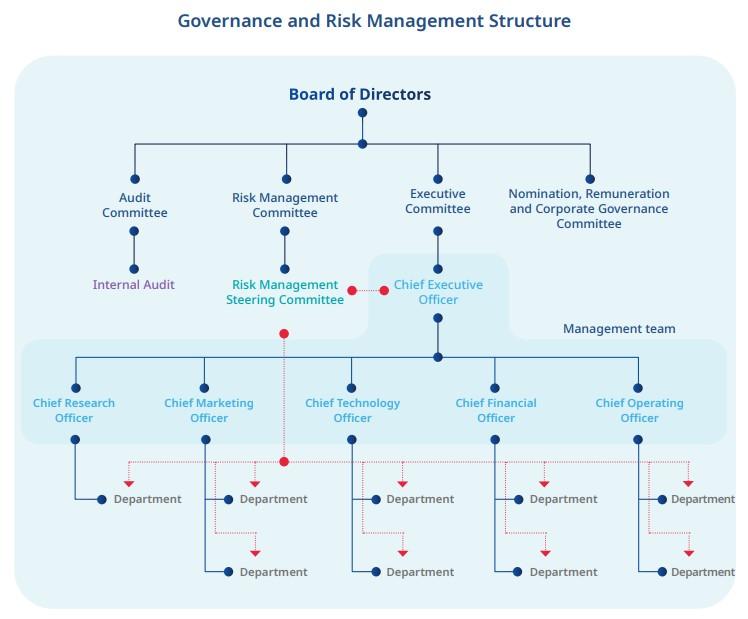
Establish a process, approach, and measures for risk management that are of international quality standards and are adequate. Additionally, provide continuous and consistent training or dissemination of knowledge (through emails, videos, and meetings) regarding risk management to ensure that all directors, senior management, and employees are well-informed.
Provide risk measurement of both qualitative (for example, the Company’s reputation and image) and quantitative (for example, loss, decreases in revenue, increases in costs) aspects based on potential opportunities and impacts.
Determine the risk limit to limit potential damage to the level of risk appetite of the organization, including monitoring the progress of the risk mitigation plan and key risk indicators (KRIs), which are a tool for early warning to prevent and determine additional risk management measures in time.
Provide written operating procedures to be implemented by executives and operators to control the risk of the operation.
The approach to risk management consists of the following steps:
Define the operational purposes and the context of the Company.
Identify risk indicators (including impacts and causes of risk) to analyze, assess, and prioritize risks.
Define criteria, risk control methods, and a risk management plans.
Monitor risk management plans and key risk indicators and conduct a risk assessment.
Communicate with employees and hold meetings with the Risk Management Committee.
Record data and prepare reports.
Besides, for continuous business operations under unexpected crises, such as natural disasters, political unrest, terrorism, epidemics, war, and various threats that will affect the ability to conduct business and may cause disruption of important processes or production chains, the Company has established a BCM (Business Continuity Management) system to support changes in the future, taking into account the safety and security of the business and the interests of all stakeholders.
The Company has assigned the Business Continuity Planning (BCP) Team, consisting of representatives from the relevant departments, to manage the business continuity plan and be representatives in communication to various departments. The Company divides its business continuity plan into three areas: asset management, product production continuity, and important data protection. The management approach can be divided into four parts: crisis prevention, incident response, crisis response, and business recovery. The Company appropriately prepares readiness and drills, as well as promoting awareness and responsibilities for employees in accordance with the business continuity management system framework.
Business Continuity Planning
Asset Management
The Company diligently manages its core assets, focusing on activities during production and readily available inventory. This involves securing warehouse insurance coverage to protect both the Company and the primary production recipient. Additionally, the Company conducts continuous assessments and monitoring of the risks associated with disaster events, ensuring preparedness for potential incidents at both the company and production recipient levels. Furthermore, the Company maintains four inventory warehouses, providing flexibility in relocating goods as needed. In the aftermath of an emergency, the Company can request additional production capacity from the production recipient to manufacture replacement products if inventory is lost or damaged.
Continuous Production Assurance
To ensure continuous production, the Company has business interruption insurance and agreements with primary manufacturers to provide uninterrupted services for specified periods, preventing unexpected disruptions. Additionally, the Company regularly exchanges business plans with manufacturers to assess situations and prepare contingency plans by identifying a secondary manufacturer. The Company can relocate production within 24 months for wafer production and within 3–6 months for IC packaging. We maintain reserve stock for core products for 3-6 months as a precaution in case of supply chain interruptions.
Critical Data Protection
The Company has stringent measures in place, such as the installation of a firewall and the implementation of two-factor authentication (2FA) to prevent unauthorized access. Following ISO27001 standards, the Company continuously adapts and updates its practices. For on-premise data management, access control is maintained through Windows login systems, and daily data backups are performed. Internally backed-up data is stored on the cloud for an additional layer of security. Cloud data management involves the use of Azure AD and Microsoft Defender to detect and respond to potential attacks. The Company can recover data from backup files, with the information being up to date within one day prior to the incident.
Policy Document Link
https://investor.sic.co.th/storage/download/corporate-governance/cg-report-and-download/20250724-sict-risk-management-policy-en.pdf
Page Number in Report
1-2
Risks to the Company's Business Operations
Risk Register
| Risk Name | Risk Characteristics | Consequences | Management Measures | Related Risk Factors |
|---|---|---|---|---|
| 1. Risks for depending on main raw material manufacturer and main supplier | The Company is engaged in the design and development of chips for RFID by outsourcing other operators to produce and assemble products (Fabless Company). Wafer Fabrication is in an upstream industry where Thai enterprises are not yet able to produce, and there are very few entrepreneurs in the industry. Globally, there are only about 10 major pure-play foundry companies. Therefore, the Company needs to import all such raw materials from abroad and must plan the order in advance, the production of integrated circuits on the wafers will take about 3-6 months. In the case of hiring a new integrated circuit manufacturer. Time must be set aside for circuit adjustments to fit new production formulas. It takes at least 6-12 months for the first production of the product. In addition, after the Company imports wafers from abroad. The Company has to hire a wafer cutting plant including IC Packaging assembly and hire form factor assembly to produce finished products, which in order to change the factory requires between 3 and 6 months of trial and quality testing, which takes less time than the integrated circuit manufacturer change, and there are more operators who can provide services in such production process. | Given the limited number of integrated circuit foundry service providers in the industry, the lengthy production lead times, and the time-consuming process of qualifying and transitioning to alternative foundry partners, any significant deviation in production planning or prolonged disruption to manufacturing operations may expose the Company to the risk of being unable to deliver products to customers within the agreed timeframes. This could result in revenue loss and may adversely affect the Company's credibility and relationships with its customers. | The Company regularly assesses the risk of production disruptions across both its IC manufacturers and assembly subcontractors by assigning dedicated personnel to coordinate production planning closely with each partner. To mitigate this risk, the Company maintains inventory levels aligned with customer demand, provides rolling six- to twelve-month forecasts to major partners with monthly reviews, and requires key IC manufacturers to provide at least twelve months' advance notice before discontinuing any product line. To reduce reliance on a single IC manufacturer, the Company has expanded its manufacturing partner base to three suppliers located in Singapore, South Korea, and the People's Republic of China. This allows the Company to design equivalent alternative products compatible with each manufacturer's process, ensuring product substitution options are available if any one supplier encounters difficulties. Decisions to add new partners also take into account R&D costs for process adaptation and order volumes required to achieve economies of scale. For wafer dicing and IC packaging services, the Company mitigates risk by qualifying backup subcontractors that have already undergone quality testing and validation. When introducing additional or alternative manufacturers, the Company works closely with affected customers by providing advance documentation and supplying product samples for customer testing and qualification. | 728 · Description: Volatility in the industry in which the company operates · Info category: STRATEGIC_RISK · 740 · Description: Shortage or fluctuation in pricing of raw materials or productive resources · Info category: OPERATIONAL_RISK · 733 · Description: Business operations of partners in the supply chain · Info category: STRATEGIC_RISK · 735 · Description: Reliance on large partners / distributors or few partners / distributors · Info category: STRATEGIC_RISK |
| 2. Risks of dependence on product or customer groups | As the Company's revenue is derived from the sale of four product groups, namely 1) Microchip for Animal Identification group, 2) Microchip for Industrial IoT group, 3) Microchip for Immobilizer group, and 4) 4. Microchip for NFC and others group. Each group of products has customers who are global major operators or customers who are distribution partners. As a result, the main source of revenue for the Company comes from the distribution of products to only 10–15 major customers. (See more details in Section Characteristics of Customers and Target Customers) | Should the Company fail to maintain the competitiveness of its products or its strong business relationships, or should any unexpected changes occur in the business of its key customers, order volumes may be adversely affected, potentially leading to a material decline in revenue. In 2025, the Company's revenue was predominantly derived from product groups 1), 2), and 3), accounting for 66%, 27%, and 7% of sales and service revenue, respectively, compared to 57%, 30%, and 12% in 2024. | The Company monitors revenue changes across product segments and tracks its top ten customers to assess concentration risk. Measures are in place to maintain strong customer relationships, including regular exchanges on product development progress and roadmaps. To reduce reliance on any single product segment or major customer, the Company promotes cross-selling to existing smaller customers and actively pursues new customer acquisition. Continuous R&D of new microchip generations across the three core product segments, as well as the newer NFC segment, supports product diversification and broader customer base expansion over time. In FY2025 and continuing into FY2026, the NFC and Advanced NFC groups remain key growth priorities. Prototype development and customer testing are ongoing, and marketing activities have begun to drive wider adoption. In FY2025, the Animal ID microchip groups accounted for 66% of total revenue, up from 57% in FY2024, driven by the mandatory adoption of electronic animal tags for livestock in South America. This segment is expected to continue growing over the long term across global markets. To mitigate revenue concentration risk, the Company has entered into long-term contracts with key customers and is actively expanding its customer base beyond Australia into other regions. Ongoing development of new microchips in the Industrial IoT and NFC segments is also intended to gradually reduce the revenue share of the Animal ID segment over time. | 728 · Description: Volatility in the industry in which the company operates · Info category: STRATEGIC_RISK · 729 · Description: Behavior or needs of customers / consumers · Info category: STRATEGIC_RISK · 734 · Description: Reliance on large customers or few customers · Info category: STRATEGIC_RISK · 1725 · Description: Income volatility · Info category: FINANCIAL_RISK · 1714 · Description: Competition risk · Info category: STRATEGIC_RISK · 1715 · Description: Economic risk · Info category: STRATEGIC_RISK |
| 3. Risks from rapid changes in technology and consumer behavior | As the Company's core business involves technology products that are susceptible to obsolescence or disruption by emerging technologies, certain product categories may experience shorter-than-anticipated product life cycles in the market. At the same time, the Company's research and development process may require several years before a product is ready for commercial sale, while technology and consumer behaviour continue to evolve at a rapid pace. As a result, by the time a product development cycle is complete, the resulting product may no longer fully address prevailing market needs, potentially causing the Company's product development projects or microchip products to lose sales and materially affecting the Company's future operating performance. | The rapid pace of technological change may result in the Company's products experiencing shorter-than-anticipated market life cycles or being displaced by emerging technologies before achieving their targeted revenue contribution. Furthermore, given that the Company's product research and development process typically spans several years, there is a risk that, by the time a product reaches commercialization, the underlying technology landscape or market requirements may have shifted materially, rendering the product unable to fully meet evolving customer needs. Such circumstances may cause the Company's product development projects or microchip products to fall short of projected sales targets or face declining market demand, potentially preventing the Company from achieving the intended return on its R&D investment. This could have a material adverse effect on the Company's revenue, competitive position, and overall operating performance going forward. | To assess and manage risks arising from rapid technological change and shifting consumer behavior, the Company's Product Management and Marketing Working Group, comprising representatives from the Marketing, Technology, Production, and Finance functions, monitors global research and emerging technologies, analyzes market trends and opportunities across product segments, and exchanges product development updates with key customers and international research institutions. These inputs are used to assess risks and opportunities and to define the Company's Technology Roadmap and Product Roadmap, both of which are reviewed every six months. The Company also conducts ongoing collaborative R&D with major customers across each business segment to ensure new products are developed and brought to market in a timely manner that genuinely meets customer and market needs. The Company currently focuses its product development on Animal ID and Industrial IoT microchips, both of which are used in manufacturing processes or as embedded components in systems where technology and market requirements evolve at a relatively gradual pace. For example, transitioning animal identification technology requires corresponding investment in related infrastructure such as reader systems and databases, making change costly and time-consuming in countries with mandatory animal registration regulations. Similarly, Industrial IoT RFID technology benefits from existing infrastructure investments that slow the pace of change. The Automotive Immobilizer segment has been affected by a contraction in the global automotive industry amid broader economic slowdown, compounded by elevated customer inventory levels. In response, the Company is developing Smart Key technology, also known as Passive Keyless Entry (PKE), which allows users to lock and unlock doors, open the trunk, and start the vehicle without physically handling the key, as well as remotely control in-vehicle functions. This represents a more advanced technology than the Company's current product offerings and is one of the key initiatives to address technology change and evolving consumer behavior. In FY2025, total revenue grew 4%, driven by a 21% increase in Animal ID revenue from key customers in Europe, reflecting the expansion of the animal identification market across the region. Automotive Immobilizer revenue declined 42% due to the contraction of the global automotive industry, while Industrial IoT revenue decreased 9% from softening orders from customers in Asia. NFC and other products grew 7%, supported by continued development of new applications and ecosystems with customers. | 728 · Description: Volatility in the industry in which the company operates · Info category: STRATEGIC_RISK · 729 · Description: Behavior or needs of customers / consumers · Info category: STRATEGIC_RISK · 732 · Description: Changes in technologies · Info category: STRATEGIC_RISK · 743 · Description: Product obsolescence · Info category: OPERATIONAL_RISK · 1725 · Description: Income volatility · Info category: FINANCIAL_RISK · 1714 · Description: Competition risk · Info category: STRATEGIC_RISK |
| 4. Risks from investment costs in research and development of products that cannot be commercially produced | The nature of the Company's business, which centres on microchip research and development and entails relatively high investment costs, the Company must continuously develop new knowledge and products to keep pace with technological advancements and evolving customer requirements. This includes foundational research that may not yet be immediately applicable to commercially saleable products but is nonetheless necessary as a knowledge base for future commercial development. R&D expenditure assessed as having commercial potential is capitalized as intangible assets in the financial statements. In 2023 - 2025, the balance of intangible assets attributable to product design and development projects amounted to THB 134.3 million, THB 183.8 million, and THB 227.2 million, representing approximately 11.6%, 18.9%, and 24.6% of total assets in each respective year. The upward trend reflects the Company's strategic investment plan in support of its long-term growth objectives. | Should any of the Company's R&D investment projects fail to proceed as planned, whether due to manufacturer delays, significant cost overruns, or material shifts in market conditions, resulting in a product's inability to enter the market on schedule, the Company may be required to recognize impairment charges or write off development costs where commercial viability can no longer be supported. This may result in relatively elevated administrative expenses and could have a material adverse impact on the Company's overall operating performance. In 2025, the Company recognized an impairment loss of THB 11.1 million on product design and development projects in progress, arising from the extension of development timelines for three projects due to the complexity of new technology development, which required longer development periods than originally estimated. The delays in bringing these new products to market resulted in a reduction in the projected discounted cash flow of future revenues, thereby necessitating the recognition of asset impairment, which was recorded as part of administrative expenses in the income statement. | To mitigate R&D-related risks, the Company prepares an annual budget with a defined R&D spending framework to guide investment planning in a manner consistent with its financial position, operating performance, and long-term growth direction. R&D project approvals follow a rigorous process requiring clear documentation of objectives, expected outcomes, and potential for future development. All projects must align with the Company's Technology Roadmap and be reviewed by the Product Management and Marketing Working Group. The Company's R&D review process is structured across five key stages: Concept, Scope, Design, Qualification, and Release. At the end of each stage, the Working Group, comprising representatives from Marketing, Technology, Production, and Finance, evaluates the business case, deliverables, timeline, and budget to determine whether the project remains on track before approving progression to the next stage. Projects that fall behind plan may be paused for review and resubmission, or closed if they are deemed unlikely to achieve their intended objectives. In FY2025, the Company refined its R&D strategy to better align product development with customer and market expectations, improving the likelihood that products reach commercial production. This approach reduces the risk of R&D investment that does not translate into tangible commercial value. During the year, the Company successfully launched six new products across the Animal ID, Industrial IoT, and NFC segments, reflecting continued R&D progress, and has begun recognizing revenue from these new product launches. Looking ahead, the Company expects to increase R&D investment to support business growth, which may result in higher intangible assets on the balance sheet. The Company regularly assesses the feasibility of its development and design projects through the process described above, adjusting development plans as circumstances evolve and recognizing asset impairment where appropriate. | 761 · Description: Insufficient sources of funding · Info category: FINANCIAL_RISK · 729 · Description: Behavior or needs of customers / consumers · Info category: STRATEGIC_RISK · 732 · Description: Changes in technologies · Info category: STRATEGIC_RISK · 743 · Description: Product obsolescence · Info category: OPERATIONAL_RISK · 1724 · Description: Liquidity risk · Info category: FINANCIAL_RISK · 746 · Description: Delays in the development of future projects · Info category: OPERATIONAL_RISK |
| 5. Risk of non-compliance with laws and regulations | Since the Company’s products are used as an element of the customer’s RFID equipment, there are various rules and standards that must be followed. Thus, in the design and manufacture of the Company’s products, various conditions or requirements must be taken into account that the customer of the Company must comply with, such as REACH (Registration Evaluation Authorization and Restriction of Chemicals), RoHS (Restriction of the Use of Certain Hazardous Substances in Electrical and Electronic Equipment), CMRT (Conflict Minerals Reporting Template), etc. In addition, the Company must comply with laws or regulations related to intellectual property, employment and labor, the protection of personal information, anti-bribery or anti-corruption, taxes, and other matters. | If the Company does not comply with the relevant laws or regulations above, it may affect the Company’s ability to sell products to its customers as expected or invest in the development of inefficient products according to the standards required by the customers, which will have a significant impact on the Company’s performance. It includes possible litigation from the Company’s customers, violations of laws, or the unawareness of changes in laws or regulations that may affect the business, leading to litigation, fines, and penalties. All of them may adversely affect the results of operations and reputation. | To mitigate regulatory risks, the Company has assigned dedicated personnel to work closely with customers to monitor and exchange information on relevant regulatory changes affecting customer products. This enables the Company to advise customers on product adaptation, feature enhancements, or new product development to meet evolving standards. Dedicated personnel are also responsible for tracking and reviewing compliance with new laws and regulations applicable to the Company's business operations, and for providing guidance to internal departments on legal and regulatory requirements. To date, the Company has not been subject to any legal action arising from non-compliance with applicable laws or regulations. The European Union has introduced the Carbon Border Adjustment Mechanism (CBAM), a regulation designed to encourage both producers and importers to align their production processes with stricter greenhouse gas emission standards, which may increase production costs and competitive pressures for affected industries. At present, CBAM does not apply to semiconductor components. Nevertheless, the Company is actively working to reduce its corporate carbon footprint and is closely monitoring developments in the CBAM framework. | 756 · Description: Change in laws and regulations · Info category: COMPLIANCE_RISK · 730 · Description: Government policy · Info category: STRATEGIC_RISK · 758 · Description: Violations of laws and regulations · Info category: COMPLIANCE_RISK · 731 · Description: Policies or international agreements related to business operations · Info category: STRATEGIC_RISK · 759 · Description: Corporate Governance · Info category: COMPLIANCE_RISK · 1723 · Description: Legal risk · Info category: COMPLIANCE_RISK · 736 · Description: Damage to company image and reputation · Info category: STRATEGIC_RISK · 1717 · Description: ESG risk · Info category: STRATEGIC_RISK · 753 · Description: Impact on human rights · Info category: OPERATIONAL_RISK |
| 6. Risk of infringement of intellectual property of other persons | As the Company's business involves research and development in pursuit of innovation and new knowledge for product development to meet customer requirements, and given that technology industry players rigorously protect their intellectual property, particularly through invention patents, there exists a risk that, in the course of developing new products, certain components or functionalities may inadvertently resemble technologies or inventions previously patented by third parties, potentially giving rise to intellectual property infringement risks. | Should any of the Company's products be determined to infringe upon the intellectual property rights of third parties, the Company may face legal action from rights holders or be ordered to cease the production and sale of such products, which could disrupt the Company's business operations and affect its customers. Furthermore, such circumstances may give rise to litigation costs or financial penalties, and could adversely affect the Company's operating performance as well as its reputation and the confidence of its customers and business partners. | To prevent intellectual property (IP) infringement risks, the Company provides regular IP training for both existing and new employees to ensure a clear understanding of IP practices and guidelines. For each product development project, the Company conducts IP risk assessments through patent searches and Freedom to Operate (FTO) analyses, which provide the basis for design decisions and help ensure that product designs do not infringe on third-party IP rights. An internal IP Working Group, comprising representatives from the Technology, Research, and Business functions as well as IP specialists, is responsible for reviewing and screening all relevant matters to prevent IP infringement. The Working Group also evaluates and files for IP protection on the Company's developed products on an ongoing basis, covering patents, petty patents, trademarks, copyrights, and other applicable rights. | 758 · Description: Violations of laws and regulations · Info category: COMPLIANCE_RISK · 1723 · Description: Legal risk · Info category: COMPLIANCE_RISK · 736 · Description: Damage to company image and reputation · Info category: STRATEGIC_RISK · 767 · Other name: - · Description: Other · Info category: FINANCIAL_RISK |
| 7. Risk of reliance on expert engineers in the terms of microchip design | As the Company's core business involves the design and development of chips for RFID system devices, its principal operations are centred on research and development, which requires reliance on specialized microchip design engineers. These engineers possess knowledge, capabilities, and experience in microchip design that represent rare and highly sought-after skills. Thailand faces significant limitations in the availability of professionals with such expertise, and the loss of key engineers could prove difficult or time-consuming to remedy through replacement hiring. In 2024 and 2025, the Company employed a total of 122 and 137 engineers, respectively, comprising: 1) expert-level engineers, 2) design management engineers, 3) microchip design engineers, 4) electronics and embedded systems engineers, and 5) manufacturing and sales support engineers. | Should the Company be unable to retain its engineering team or source suitably qualified replacements, particularly microchip design engineers for whom demand grows each year, this may adversely affect new product research and development, including delayed product delivery, substandard product quality, or failure to meet customer specifications, ultimately impacting the Company's future revenue growth. | To assess employee retention risk, the Company conducts an annual employee engagement survey and collects anonymous questions and feedback from employees through quarterly Town Hall meetings. Results and feedback are used to drive continuous improvement. The Company has also established a Retention Program for key specialists and talented employees, incorporating long-term planning to maintain organizational capability at a level competitive within the chip design industry. Initiatives under this program include special compensation consideration, an Employee Joint Investment Program linked to annual company performance, and long-term career development planning. The Company promotes a knowledge-sharing culture through structured top-down mentoring, enabling senior engineers to transfer expertise to junior engineers across all levels on an ongoing basis. To reduce reliance on individual employees, the Company practices management decentralization and engineering team rotation. Engineers are also supported through regular training and overseas study visits to keep their skills current with global technology trends and on par with leading international companies in the industry. To address the risk of insufficient specialist talent, the Company collaborates with academic institutions to develop relevant knowledge and human capital. Activities with universities across Thailand aim to educate engineering students in fields related to the Company's business, raise awareness of career pathways in the industry, and grow the overall pool of qualified professionals. The Company also plans to recruit specialist talent from overseas where needed. In FY2025, the Company signed memoranda of understanding with the Thai Semiconductor Industry Association (THSIA) and a network of 19 universities nationwide, with the goal of developing a comprehensive talent pipeline in microelectronics and semiconductors. The Company also welcomed interns from universities across Thailand, including Chulalongkorn University, Kasetsart University, King Mongkut's Institute of Technology Ladkrabang, and Prince of Songkla University, providing hands-on experience in the semiconductor industry. | 738 · Description: Reliance on employees in key positions · Info category: OPERATIONAL_RISK · 739 · Description: Shortage or reliance on skilled workers · Info category: OPERATIONAL_RISK · 742 · Description: Human error in business operations · Info category: OPERATIONAL_RISK · 746 · Description: Delays in the development of future projects · Info category: OPERATIONAL_RISK |
| 8. Risks from fluctuations in foreign exchange rates | As the Company conducts almost entirely export-based operations, product pricing with customers is denominated primarily in U.S. dollars and euros. In addition, the Company imports wafers from overseas, with payments settled principally in U.S. dollars. The Company is therefore exposed to foreign exchange rate volatility, which directly affects its Baht-denominated revenue and profit. Overseas sales accounted for approximately 99% of total sales revenue. | Foreign exchange rate fluctuations may have a material impact on the Company's financial performance, both positively and negatively. A depreciation of the Thai Baht results in higher Baht-denominated revenue recognition, thereby increasing net profit, while an appreciation of the Thai Baht produces the opposite effect. In addition, foreign exchange gains or losses may arise from the difference between the exchange rate applied at the date of recording a sale or raw material purchase and the rate prevailing at the date of actual receipt or payment. | To mitigate foreign exchange risk, the Company closely monitors currency movements and regularly assesses exchange rate trends across relevant currencies. Cash inflows and outflows in the same foreign currency are planned and matched accordingly. The Company does not engage in any form of foreign exchange speculation. | 764 · Description: Fluctuation in exchange rates, interest rates, or the inflation rate · Info category: FINANCIAL_RISK · 1725 · Description: Income volatility · Info category: FINANCIAL_RISK · 1715 · Description: Economic risk · Info category: STRATEGIC_RISK |
| 9. Risk from climate change | Climate change is considered an ESG (Environmental, Social and Governance) risk that has the potential to affect the Company's business operations both directly and indirectly. Such changes may give rise to more frequent and severe weather events and natural disasters, including floods, storms, and heatwaves, which could disrupt the infrastructure, logistics, and operations of stakeholders across the Company's supply chain. Furthermore, climate change may prompt regulators to introduce increasingly stringent environmental policies, regulations, and measures, which could affect the future business operations of the Company and its supply chain partners. | Climate change risks may expose the Company's supply chain partners or manufacturers located in vulnerable areas to natural disasters or severe weather events, potentially disrupting production processes or raw material delivery, and thereby affecting the continuity of the Company's business operations. In addition, the need to comply with increasingly stringent environmental regulations, such as greenhouse gas emission reduction measures or other environmental requirements, may result in higher operating costs for the Company and its supply chain partners, and could adversely affect the Company's operational performance and financial results over the long term. | The Company has assigned dedicated personnel to regularly monitor climate change developments and related laws and standards. An annual corporate carbon footprint assessment is conducted, and the Company has begun collecting Scope 3 greenhouse gas emission data for the first time to evaluate the effectiveness of its sustainability strategy. Supplier Business Continuity Plans (BCPs) are also assessed as part of the supplier selection process to ensure that contingency plans are in place and that raw material delivery can be maintained. Overall, the Company and its manufacturing partners are less directly exposed to climate change impacts compared to other industries. | 756 · Description: Change in laws and regulations · Info category: COMPLIANCE_RISK · 730 · Description: Government policy · Info category: STRATEGIC_RISK · 731 · Description: Policies or international agreements related to business operations · Info category: STRATEGIC_RISK · 750 · Description: Climate change and disasters · Info category: OPERATIONAL_RISK · 751 · Description: Impact on the environment · Info category: OPERATIONAL_RISK · 1717 · Description: ESG risk · Info category: STRATEGIC_RISK · 1719 · Description: Climate change and disasters · Info category: STRATEGIC_RISK |
| 10. Risk on human rights | Human rights risk is considered an ESG (Environmental, Social and Governance) risk that may arise from the Company's own business operations as well as those of its suppliers and stakeholders across the supply chain. Such risks may stem from non-compliance with labour and human rights standards, including forced labour, child labour, discrimination, harassment or workplace violence, and violations of the fundamental rights of employees or related parties. Human rights issues are receiving increasing attention from regulators, customers, investors, and international business partners, and the Company may face reputational and operational risks should it fail to manage these matters appropriately. | Should human rights violations occur within the Company's operations or supply chain, such incidents may lead to stakeholder complaints, regulatory investigations, or legal proceedings, potentially resulting in litigation costs or financial penalties. Furthermore, such events may adversely affect the Company's image and reputation, as well as the confidence of customers, investors, and business partners, and could ultimately impact the continuity of the Company's business operations and its long-term financial performance. | The Company has established a human rights policy in alignment with both national and international regulations and standards, including the International Labour Organization (ILO) Declaration on Fundamental Principles and Rights at Work, the Responsible Business Alliance (RBA) Code of Conduct applicable to the electronics industry, the Company's internal human resources management policy, and applicable Thai laws. In addition, the Company conducts a Human Rights Due Diligence process to identify issues, assess risks and potential impacts related to human rights violations within the organization, determine affected groups or individuals, develop remediation and prevention plans, implement corrective and preventive measures, and monitor outcomes. The Company ensures that appropriate and effective remediation mechanisms are in place in the event of human rights violations. To this end, the Company provides multiple channels for receiving complaints, feedback, whistleblowing reports, and notifications of unlawful acts, regulatory breaches, or violations of the Company's Code of Conduct, accessible via postal mail, email, the Company's website, and telephone. Individuals who report concerns in good faith are afforded protection under the Company's whistleblower protection measures, including strict confidentiality of the reporter's identity. In 2025, the Company had no incidents of human rights violations within the organization and received no complaints or tips regarding human rights violations of employees and stakeholders associated with the Company. | 758 · Description: Violations of laws and regulations · Info category: COMPLIANCE_RISK · 730 · Description: Government policy · Info category: STRATEGIC_RISK · 731 · Description: Policies or international agreements related to business operations · Info category: STRATEGIC_RISK · 1723 · Description: Legal risk · Info category: COMPLIANCE_RISK · 736 · Description: Damage to company image and reputation · Info category: STRATEGIC_RISK · 749 · Description: Safety, occupational health, and working environment · Info category: OPERATIONAL_RISK · 1717 · Description: ESG risk · Info category: STRATEGIC_RISK · 753 · Description: Impact on human rights · Info category: OPERATIONAL_RISK |
| 11. Geopolitical Tension Risk | Given the increasing complexity and interconnectedness of the global economy, political landscape, and social environment, geopolitical tensions have become an unavoidable risk to manufacturing supply chains. The Company recognizes this as a significant emerging risk and actively monitors the following key conflict situations that may affect its operations:
| Geopolitical tensions may adversely affect global economic stability and the semiconductor industry's supply chain, particularly in circumstances involving the imposition of trade barriers, technology export restrictions, or changes in tariff policies, any of which could disrupt the cross-border trade and movement of technology goods. Furthermore, international conflicts may indirectly affect energy prices, inflation, and raw material costs, potentially leading to higher production and operating costs for the Company as well as its supply chain partners. | The Company has assigned dedicated personnel to monitor geopolitical developments and gather information from relevant suppliers to assess the situation on an ongoing basis. At present and in the near term, trade conflicts have not affected the Company as its products are not subject to any restricted or controlled categories. The Russia-Ukraine conflict has similarly not impacted the Company's supply chain. However, should the Middle East conflict escalate, the Company could face higher energy costs, increased freight expenses, and longer delivery lead times. To address these risks, the Company has prepared supply chain contingency plans to minimize potential disruptions, along with cost management strategies to offset the impact of rising input costs, while continuing to monitor developments closely. | 756 · Description: Change in laws and regulations · Info category: COMPLIANCE_RISK · 728 · Description: Volatility in the industry in which the company operates · Info category: STRATEGIC_RISK · 740 · Description: Shortage or fluctuation in pricing of raw materials or productive resources · Info category: OPERATIONAL_RISK · 731 · Description: Policies or international agreements related to business operations · Info category: STRATEGIC_RISK · 1715 · Description: Economic risk · Info category: STRATEGIC_RISK |